

1.State two Structural differences between the nymph of cockroach and an adult cockroach.
2. List three characteristic features of cross-pollinated flowers.
3. Give a reason why the testes in most mammals are located outside the body cavity
4. State the structure used by each of the following organism for movement: (a) Ameba (b) Euglena (c) Paramecium.
5. List three types of stimuli detected by the sensory nerve endings on the skin.
6. Explain the function of the ciliary muscles of the eye.
7. How many “daughter” cells are produced in (a) meiosis (b) mitosis?

8. The graphs show the limit of tolerance of some species of fish I, Il and lll to water temperature. (a) From the graphs, what can you deduce about the geographical range of species i and ili? (b) What is the optimal temperature for growth of species I, Il and IIl?
9. Name three abiotic factors which plants growing close to each other may compete for?
10. Name four excretory products of plants.
11. (a) (i) identify specimens A, B,C and D without reasons. (ii) To which class of animals do specimens B and C belong? (ii) State the excretory structures possessed by each of specimens B and D. (b) State two external features used by specimen C for gaseous exchange. (c) Mention (i) three structural similarities (i) two structural differences between specimens B and C (d) Make a labeled drawing 8-10 cm long of the ventral view of specimen A.
12. (a) identify specimen E without reasons. (b) Make a labeled drawing 8-10cm long of the cut surface of specimen E.
13.(a) identity specimens F, GH, I, J and K without reasons. (b) Copy and complete the table below into your answer booklet
Put a tick ( ✓ ) where appropriate
| SPECIMEN | ANNUAL | PERENNIAL | CASH CROP | FOOD CROP |
| F | ||||
| G | ||||
| H | ||||
| I | ||||
| J | ||||
| K |
(a) Define the term organic evolution
(b) Outline the contribution of
(i) Larmack
(ii) Darwin to organic evolution
(c) List three evidences of organic evolution
(d) Explain the role of
(i) Mutation
(ii) Isolation in the form of new species
(a) mention four caste found among termite nests
(b)(i) state one role of each caste to the colony.
(ii) mention two ways by which termites are of economic importance to man
(c)(i) mention two types of courtship behaviour in lower animals
(ii) state two importance of courtship behaviour in the reproduction of lower animals
(d) Describe briefly the courtship behaviour exhibited by Agama lizard
(a) List four floral parts of a flower.
(b) (i) In a tabular form, state five differences between wind and insect pollinated flowers.
(ii) Give one example of each.
(c) (i) State three agents of fruit and seed dispersal.
(ii) Give an example of fruits or seeds dispersed by each agent
(d) (i) Define the term “hormones.
(ii) Name one plant hormone.
(iii) State two effects of plant hormones.
(a) (i) Name the two stages involved in photosynthesis.
(ii) Write an equation to represent the first stage of photosynthesis.
(b) (i) List six modes of nutrition in organisms.
(ii) Name one feature that makes feeding possible in the following organisms: I. Paramecium; II Spirogyra; Ill Rhizopus; IV Tape worm.
(c) Define the term balanced diet.
(d) (i) State three characteristics of enzymes.
(ii) in a tabular form, indicate the source, substrate acted upon and the product of the following enzymes: ptyalin and pepsin.
Which of the following examples best describes camouflagic colouration in organisms?
- A. A butterfly which has a real colouration on the wing
- B. A green snake in a green grass
- C. zebra with vertical stripes on the body
- D. Certain tree frogs with bright colour patterns
- E. A flower whose petals and sepals are of the same colou

Which off the following makes up the bee caste?
- A. Soldiers and Queen
- B. Drones, soldiers and workers
- C. Queen, workers and soldiers
- D. Queen, drones and workers
- E. Soldiers, Queen and drones
Termites are called social insects because
- A. the nests are built by the nasute soldiers
- B. they live together in communities
- C. the queen allocates duties to the workers
- D. the king and queen do mate
- E. the function of the workers and soldiers are very important
In a cross involving a heterozygous red flowered plant (Rr) and a white flowered plant (rr). what is the
probability that the offspring will be Rr?
- A. 1
- B. 1\2
- C. 1\4
- D. 3\4
- E. 2
In a plant of genotype Tt, what is the probability that a gamete will contain gene t?
- A. 1\2
- B. 3\4
- C. 1\8
- D. 1\6
- E. 1\4
How many chromosomes will be present in a gamete if the somatic cell has eight(8) chromosomes?
- A. 4
- B. 6
- C. 8
- D. 10
- E. 16
In animals the main protective covering is found in the
- A. adipose tissues
- B. epithelial tissues
- C. bone tissues
- D. 'connective tissues
- E. vascular tissues
Oil is sprayed over stagnant water in which mosquitoes breed in order to
- A. provide landing surface for the adult
- B. prevent larva or pupa from attaching itself to the surface
- C. prevent the water from overheating
- D. lubricate the larva for easy movement
- E. provide surface for laying their eggs
Which of the following statements about poliomyelitis is not correct. It
- A. is a bacterial disease
- B. is capable of paralysing the limbs
- C. can be prevented by immunization
- D. is an infant disease
- E. may cause wasting of the limb muscles
which of the following plant parts is not a storage organ?
- A. Carrot root
- B. Sugarcane stem
- C. Onion leaf
- D. Banana stem
- E. Cassava root
The earthworm is important because
- A. its body is always moist
- B. each of its segments has chaetae
- C. It has a clitellum
- D. it aerates the soil
- E. it reproduces fast
Which of the following organisms will be a colonizing species of a heap of moist sub soil?
- A. Green algae
- B. Ferns
- C. White mangrove
- D. Snails
- E. Tadpole
Excessive loss of water from the leaf is prevented by the
- A. vascular bundle
- B. cuticle
- C. midrib
- D. parenchyma
- E. mesophyll.
The presence of stilt and breathing roots are features of plants found in the
- A. tropical rain forests
- B. fresh water swamp forests
- C. mangrove forests
- D. southern guinea savanna
- E. northern guinea savanna.
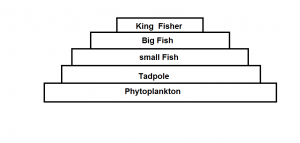
Which of these organisms is a herbivore?
- A. Tadpole
- B. Phytoplankton
- C. King Fisher
- D. Small fish
- E. Big fish
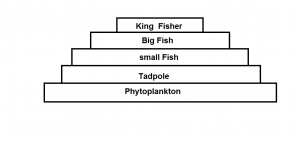
Which of these organisms occupies the 3rd trophic
level?
- A. King fisher
- B. Small fish
- C. Phytoplankton
- D. Big fish
- E. Tadpole.