


The diagram above illustrates
- A. the size of various organisms
- B. types of organisms in a habitat
- C. the flow of energy in a habitat
- D. the hierarchy of organisms in a habitat
- E. the food chain

In a food chain, each stage in the chain is a
- A. chain level
- B. web level
- C. consumption level
- D. trophic level
- E. product level
Which of the following instrument can be used to measure relative humidity?
- A. Anemometer
- B. Hygrometer
- C. Wind gauge
- D. Barometer
- E. Thermometer
Which of the following contains a reducing sugar?
- A. Milk
- B. Cassava
- C. Grapefruit
- D. Beans
- E. Plantain
Hydra feeds by
- A. digesting its food extra cellularly
- B. absorbing food digested by other organisms
- C. symbiotic association
- D. masticating the food particles
- E. synthesising its food chemically
Which of the following plants is a carnivore?
- A. Desmodium
- B. Sundew
- C. Mushroom
- D. Platycerium
- E. Liverwort
The enzyme that acts on milk in the stomach is
- A. invertase
- B. trypsin
- C. diastase
- D. renin
- E. ptyalin
The pancreatic duct opens into the
- A. caecum
- B. colon
- C. ileum
- D. duodenum
- E. oesophagus
Which of the following organisms has homodont dentition?
- A. Rabbit
- B. Man
- C. Sheep
- D. Cat
- E. Lizard
The mode of nutrition which describes feeding habit in animals is
- A. autotrophic
- B. holozoic
- C. holophytic
- D. saprophytic
- E. photosynthetic
The role of bacteria in the nitrogen cycle includes the following except
- A. fixing atmospheric nitrogen
- B. converting ammonia to nitrites
- C. converting nitrites to nitrates
- D. converting carbohydrates to carbondioxide
- E. causing the decay of dead organisms
Which of the following processes removes CO2 from the atmosphere?
- A. Respiration
- B. Photosynthesis
- C. Transpiration
- D. Excretion
- E. Combustion
In testing for starch in a leaf the function of alcohol is to
- A. kill the cells of the leaf
- B. soften the veins of the leaf
- C. aid iodine to penetrate the cells
- D. be a component of the heating bath
- E. extract the chlorophyll from the leaf
Which of the following is a feature of wind pollinated flowers?
- A. Large and brightly coloured petals
- B. Possession of sweet scent
- C. Presence of nectar
- D. Presence of pollen guides
- E. Smooth, light and numerous pollen grains
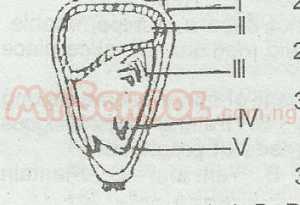
The function of the part labelled V in the diagram is the
- A. manufacture of food
- B. storage of food
- C. secretion of digestive enzymes
- D. protection of the radicle
- E. absorption of mineral salts

The part labelled IV in the diagram is the
- A. plumule
- B. endosperm
- C. radicle
- D. coleoptile
- E. pericarp

The part labelled II in the diagram is the
- A. plumule
- B. endosperm
- C. radicle
- D. coleorhiza
- E. pericarp
If the petals of a flowering plant are removed. Which of the following processes is likely to be affected?
- A. Transpiration
- B. Pollination
- C. Germination
- D. Photosynthesis
- E. Dispersal
The collective name for the female parts of the flower is
- A. gynoecium
- B. androecium
- C. ovary
- D. stigma
- E. style
Which of the following mammalian features acts as a shock-absorber to the developing embryo?
- A. Amniotic fluid
- B. Umbilical cord
- C. Placenta
- D. Amnion
- E. Chorion
Which of the following organisms lacks a reproductive organ?
- A. Chlamydomonas
- B. Toad
- C. Pride of Barbados
- D. Cockroach
- E. Man