

The following are the major reasons why the butterfly lays eggs under the surface of a leaf except to
- A. shade the eggs from the direct rays of the sun.
- B. protect the eggs from predators
- C. protect the eggs from being washed away by rain drops
- D. camouflage the eggs

Transportation of water in the xylem tissue involves the following except
- A. root pressure
- B. capillary action
- C. transpiration pull
- D. translocation
Which of the following statements ls true about transpiration? It is the
- A. loss of water in the form of vapour from the surface of the’ leaf
- B. loss of water in the form of vapour from the surface of the root
- C. absorption of water in the form of vapour from the body of the pint
- D. movement of water through the body of the plant.
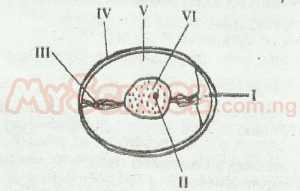
The part labelled III is the
- A. albumen
- B. chalaza
- C. yolk
- D. air space
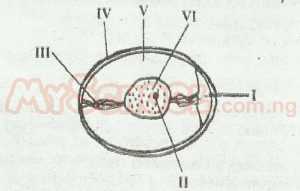
The parts that supply food and water to the developing embryo are labelled
- A. I and II
- B. III and V.
- C. V and VI
- D. I and III
Which of the following statements about the development of the foetus is not correct?
- A. The circulatory system of the foetus is directly connected to the maternal blood vessels
- B. The foetus depends on the mothers blood for its food and oxygen
- C. The foetus is surrounded by a water sac
- D. Food and oxygen are carried across the placenta to the embryo’s blood
The relationship between the retina and the brain is similar to that between the
- A. cochlea and the auditory nerve
- B. cochlea and the brain.
- C. cochlea and the semi-circular canals
- D. eardrum and the brain
The ear pinna is strengthened by
- A. blood pressure.
- B. cartilage
- C. bone
- D. turgor pressure
The organ that receives reduced flow of blood during vigorous exercise is the
- A. brain
- B. heart
- C. lung
- D. limb
The excretory system in mammals consists of the following parts except
- A. two kidneys
- B. two ureters
- C. two bladders
- D. one urethra
The following characteristics are associated with the mammalian lungs except
- A. large surface area
- B. expandable lungs
- C. moist surface
- D. highly vascularized
A pulse is best described as
- A. contraction of arteries to let out blood.
- B. contraction of veins to allow blood into them
- C. dilation of arteries to accommodate blood rushing through.
- D. pumping action of the heart to move blood round the body.
The inorganic components of bone consist of
- A. magnesium, sodium and calcium
- B. magnesium, phosphorus and calcium
- C. sodium, phosphorus and calcium,
- D. potassium, magnesium and calcium
The axial skeleton is composed of the
- A. skull and vertebral column
- B. limbs and girdles
- C. atlas and axis.
- D. radius and ulna
Excretion in Paramecium sp. is by diffusion because
- A. its habitat is water and moist places
- B. it has simple, small and few internal organs
- C. it has a large surface area to volume ratio.
- D. it has a large efficient meganucleus.
In cellular respiration energy is made available to organisms by
- A. removal of a phosphate group from ADR
- B. breaking off a phosphate group from ATP
- C. adding a phosphate group to glucose
- D. breaking off a hydrogen ion from NADPH
The mechanism of opening and closing of stomata in plants is based on
- A. turgidity and diffusion
- B. turgidity and flaccidity
- C. osmosis and diffusion
- D. diffusion and flaccidity
Which of the following processes involves diffusion?
- A. Opening and closing of stomatal pores
- B. Turgidity of herbaceous plants
- C. Absorption of water through the root hairs
- D. Absorption of digested food into the villi
Which of the following characteristics do fungi share in common with animals?
- A. Presence of digestive tract
- B. Movement from one place to another
- C. Storage of carbohydrates as glycogen
- D. Movement of centrioles during cell division
A typical plant cell is mainly distinguished from an animal cell by the possession of
- A. chloroplast and nucleus
- B. cell wall and cytoplasm
- C. chloroplast and cell wall
- D. cell wall and mitochondrion
Which of the following cell types has the least number of mitochondria?
- A. Cardiac cells of the heart
- B. Cells of the cornified layer
- C. Muscle cells of the bladder
- D. Muscle cells of the diaphragm