

The chemical bond that holds the bases of the two strands of DNA together is
- A. oxygen bond
- B. hydrogen bond
- C. electrovalent bond
- D. covalent bond

A plant cell has 14 chromosomes prior to mitosis. What is the number of chromosomes in the daughter cells?
- A. 14
- B. 56
- C. 28
- D. 7
Genes that remain linked are those
- A. close to each other on the chromosomes
- B. on the same locus on the chromosomes
- C. on the homologous chromosomes
- D. which are allelic pair
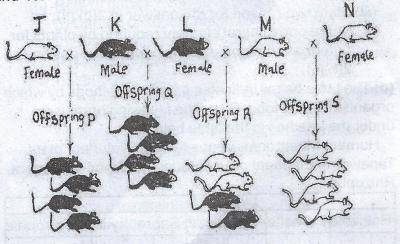
The diagrams above are illustrations of the inheritance of coat colour in mice. J, K, L, M and N are parents. The cross between two parent mice gave rise to offspring P, Q, R and S. Which of the offspring are all homozygous?
- A. P
- B. Q
- C. S
- D. R
The exchange of genes between homologous chromosomes is called
- A. crossing over
- B. back cross
- C. test cross
- D. mutation
The greatest contribution to genetic studies was made by
- A. Gregor Mendel
- B. Thomas Morgan
- C. Charles Darwin
- D. Robert Hooke
Two unconscious patients X and Y whose blood group genotypes are AO and AB respectively were transfused with the blood from the same donor . Patient X immediately showed signs of difficulty in breathing while patient Y showed no negative reaction.
What should the hospital have done to prevent X from showing the symptom described above? Patient X should have
- A. undergone an agglutination test
- B. been asked for the blood group
- C. been screened for HIV
- D. undergone malaria test
Two unconscious patients X and Y whose blood group genotypes are AO and AB respectively were transfused with the blood from the same donor . Patient X immediately showed signs of difficulty in breathing while patient Y showed no negative reaction.
Patients X and Y were likely transferred with blood of genotype
- A. OO
- B. AO
- C. BO
- D. AA
Conservation of wildlife is necessary mainly because
- A. wild species cannot resist disease better than their domesticated species
- B. many predator wild animals help in the control of pests
- C. it prevents extinction of species
- D. many people derive pleasure from observing wild animals
Which of the following disease ic caused by a bacterium?
- A. ringworm
- B. poliomyelitus
- C. syphilis
- D. malaria
When large numbers of organisms share limited space and resources, the immediate result is
- A. extinction
- B. emigration
- C. competition
- D. immigration
An association between living organisms in which one lives on and feeds at the expense of the other is known as
- A. commensalism
- B. predation
- C. parasitism
- D. mutualism
Xerophytes have the following characteristics aimed at conserving water except
- A. thick cuticle
- B. broad leaf surfaces
- C. sunken stomata
- D. waxy cuticle
In an ecosystem, the least efficient energy transfer link is from the
- A. secondary consumers to decomposers
- B. sun to producers
- C. primary consumers to secondary consumers
- D. producer to primary consumers
Which of the following instruments is used to determine the turbidity of water?
- A. hygrometer
- B. hydrometer
- C. secchi disc
- D. rain gauge
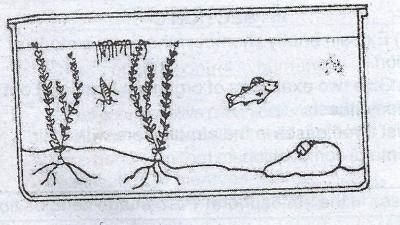
The diagram above is an illustration of organisms in an air-tight aquarium.The most important factor needed by the organisms is
- A. light energy
- B. low humidity
- C. oxygen
- D. nitrate
The most important factor(s) that influence(s) the ecological niche of an organism is/ are the
- A. water, light and predator-prey relationship
- B. food and water availability
- C. physical environment
- D. competition for food and space
Which of the following statements would be a correct observation at the end of the experiment? Water moves
- A. highest in sandy soil
- B. lowest in loamy soil
- C. to the same level in all soil types
- D. highest in clayey soil
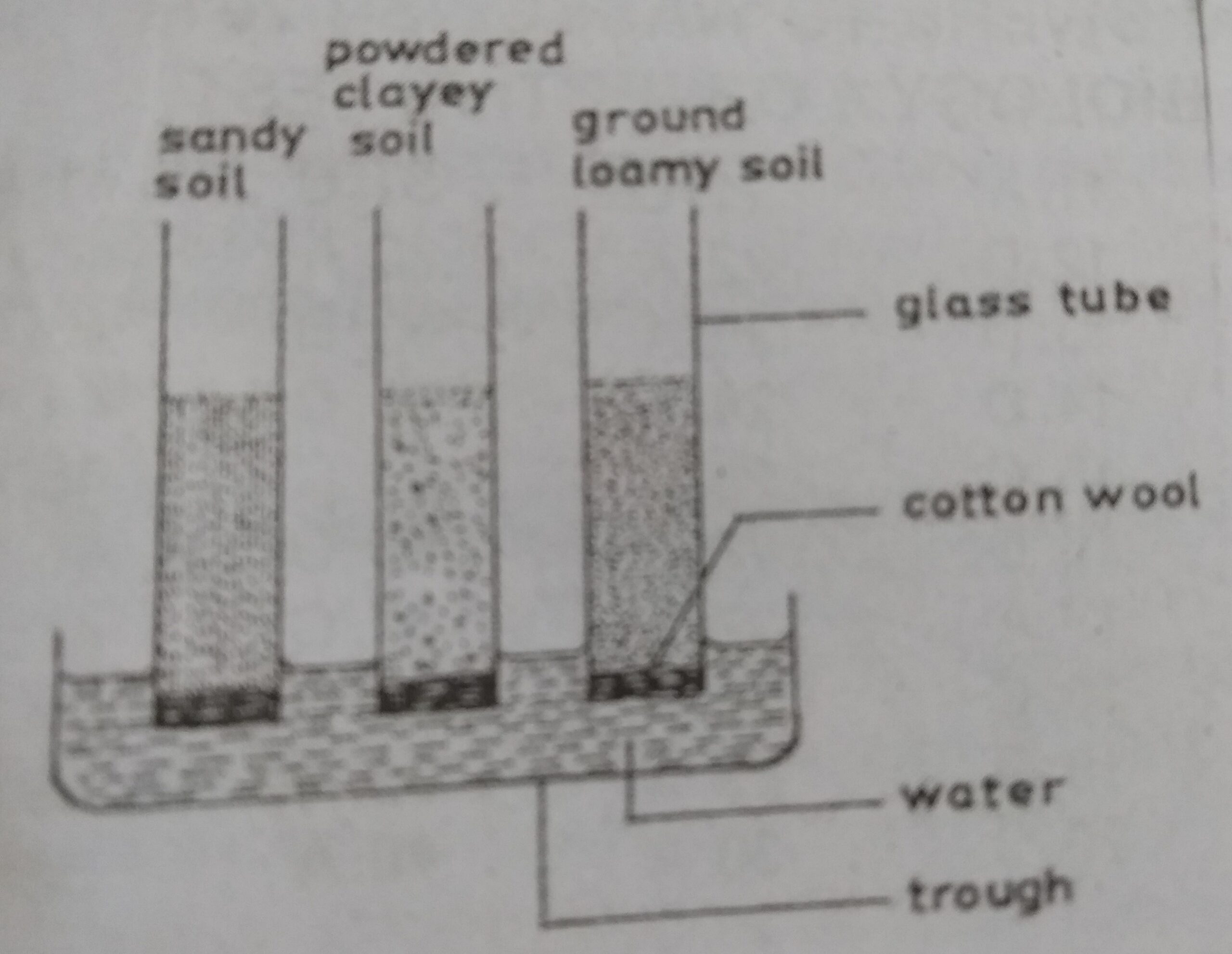
The diagram above is an illustration of an experimental set-up to demonstrate a property of soil. The property of soil demonstrated is
- A. particle size
- B. capillarity
- C. colour
- D. texture
Which of the following dental formulae represents the dentition in rabbits?
- A. \(I\frac{2}{1}\) \(C\frac{0}{0}\) \(P\frac{3}{2}\) \(M\frac{3}{3}\)
- B. \(I\frac{2}{2}\) \(C\frac{1}{1}\) \(P\frac{2}{2}\) \(M\frac{3}{3}\)
- C. \(I\frac{1}{2}\) \(C\frac{0}{0}\) \(P\frac{2}{3}\) \(M\frac{3}{3}\)
- D. \(I\frac{2}{1}\) \(C\frac{0}{1}\) \(P\frac{3}{2}\) \(M\frac{3}{3}\)
The duodenum of a person was surgically removed. Which of the following substances would have their digestion affected?
- A. starch and protein only
- B. starch and lipids
- C. starch, peptones and maltose
- D. starch, protein and lipids