(a) Explain briefly the following terms:
- ecosystem;
- abiotic environment.
(b) List three ecological factors each which are specific to:
- aquatic habitats;
- terrestrial habitats.
(c) State briefly the relationship between green grass and a rabbit in a given habitat.
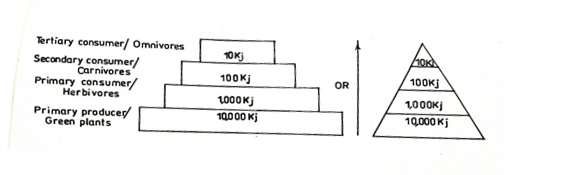
(d) Draw a typical pyramid of energy using four feeding levels.
Explanation
(a) (i) Ecosystem:
Is a natural unit consisting/made up of living/biotic/organism and non-living/abiotic elements/factors; interacting to produce a stable system.
(ii) Abiotic environment:
The non-living components of the ecosystem; such as light/pH/water/oxygen/wind/temperature etc.
(b) Ecological factors that are specific to:
(i) Aquatic habitat
Salinity; turbidity; tidal movement; dissolved gases; density; substratum; water current.
(ii) Terrestrial habitat
Humidity; soil; topography; wind; altitude; availability of water.
(c) The relationship between grass and rabbit in a given habitat
- Grass (green plants) can photosynthesize/ manufacture its food;
- Rabbit which cannot manufacture its food feeds on grass;
- During respiratory process, rabbit gives out carbon dioxide as a waste product;
- Grass makes use of the carbon dioxide to manufacture its food;
- Grass during photosynthesis gives out oxygen as a by-product which the rabbit uses for respiration;
When a rabbit defecates/ dies, bacteria/fungi cause its decay, which forms manure that is absorbed as soil nutrients by grass.
(d) Pyramid of energy