

The diagrams below are illustrations of two organisms. Study them and answer question 3 (a) to (f)
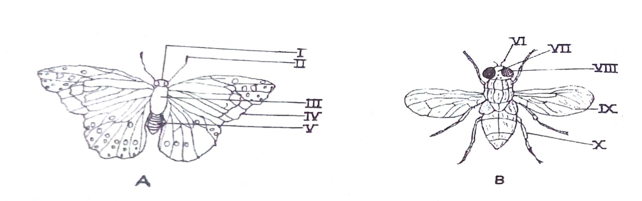
(a)(i) Identify organisms A and B.
(ii) Name the parts labeled I to X.
(b) State one function each of the parts labeled VI, VIII, IX and X.
(c) Name the specific habitats of organisms A and B.
(d) State three structural adaptations of organism A to its mode of life.
(e)(i)State three structural similarities between organisms A and B.
(ii) State three structural differences between organisms A and B.
(f)(i) Name the class of organisms A and B.
(ii) State three reasons for the answer in (f) (i).
(g)State one biological importance of organism A.
Explanation
(a) (i) Identification of organisms
A – Butterfly/Papilio sp.
B – Housefly/Musca sp.
(ii) Name of labeled parts
I- Head; VI- Antenna;
II- Antenna; VII- Head;
III- Thorax; VIII- Compound eye;
IV- Fore(wing); IX- fore (wing);
V- Abdomen; X- leg.
(b) Function of parts
VI - Antenna: for feeling/ sensitivity (to touch/smell/vibrations);
VIII - Compound eye: for seeing/ sight/vision;
IX - wing: for balancing/flying/ flight;
X - leg: for walking/ crawling/ running.
(c) Specific habitats of organisms A and B
A /Butterfly: Garden, farm/ flowering plants/ trees;
B /Housefly: Latrines/ toilets/ refuse dumps/ exposed food/ sewage/ decaying organic matter.
(d) Structural adaptations of organism A
- Large/ broad wings; for flight;
- Long thin proboscis/mouthpart; for sucking nectar;
- Long clubbed antennae; for sensitivity;
- Large compound eyes; for vision .
Note: The structure must be correctly qualified to score; but 1mark will be awarded for correct function.
(e) (i) Structural similarities between organisms A and B
Both possess
- Wings;
- Three body divisions/head, thorax and abdomen;
- A pair of antennae;
- A pair of compound eyes.
- Segmented body
(ii) Structural differences between organisms A and B
A/Butterfly |
B/Housefly |
|
Broad wings |
Narrow wings; |
|
Antennae is clubbed/knobbed |
Antennae is not clubbed/knobbed; |
|
Long antennae |
Short antennae; |
|
Smaller compound eyes |
Bigger compound eyes; |
|
Scales present |
Scales absent; |
|
Hind wings present |
Hind wings reduced to halters; |
|
Simple eyes absent |
Simple eyes present; |
|
Hair absent |
Hair present; |
(f) (i) Class of organisms A and B
Insecta
(ii) Reasons for the answer in (f) (i)
- Presence of wings;
- Three body divisions/ head, thorax and abdomen;
- A pair of antennae;
- Three pairs of jointed legs (on the thorax);
- Presence of a pair of compound eyes;
- Segmented body.
(g) Biological importance of organism A
- It pollinates flowers;
- It is a source of food for some organisms.