

The demand curve would shift to the left when there is a rise in
- A. Constant proportions
- B. Constant complement
- C. Income
- D. The supply of the commodity


Which of the following graphs represents the price-quantity relationship between tea and lemon, if they are perfect complements? choose the answer from the option above
- A. A
- B. B
- C. C
- D. D
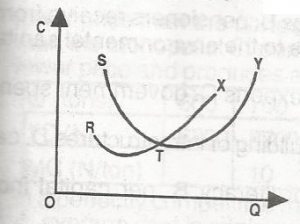
In the diagram above, RTX and STY are the marginal cost and the average cost curves responsively of a perfectly competitive firm. The supply curve of the firm is indicated by
- A. TX
- B. RT
- C. ST
- D. TY
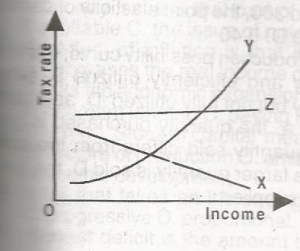
THE RELATIONSHIP BETWEEN TAX RATE AND INCOME WHICH IS RELEVANT TO A PROPORTIONAL TAX IS DEPICTED BY
- A. CURVES Z AND Y
- B. CURVE X
- C. CURVE Z
- D. CURVE Y
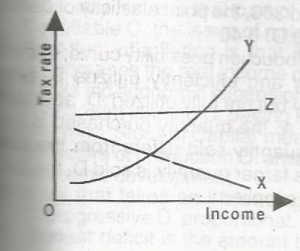
The relationship between tax rate and income which is relevant to a progressive tax is shown by
- A. curve X
- B. curveY
- C. curve Z
- D. curve X and Z
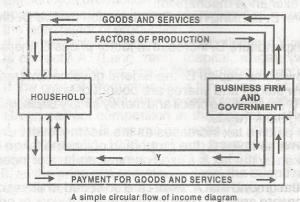
The lower half of the diagram indicates
- A. the flow of goods and services
- B. payments for goods and services
- C. the flow of income
- D. government transactions
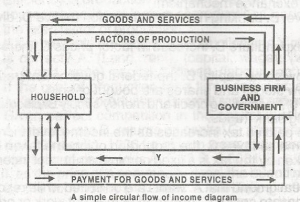
The flow labelled Y refers to
- A. real income
- B. factor payment
- C. factor input
- D. national income
Agriculture is central to Nigeria”s economic development because?
- A. Nigeria''s comparative advantage lies mainly in agro-allied industries
- B. agriculture is the largest employer of labour
- C. agriculture accounts for an insignificant domestic product
- D. Nigeria earns limitless foreign exchange from agriculture
The most common index used for measuring development is?
- A. the level of literacy
- B. per capita income
- C. nutritional levels
- D. population growth rate
Social overhead capital refers to?
- A. balanced growth
- B. gross investment
- C. the building of infrastructures
- D. capital formation
in equilibrium, injections are equal to?
- A. withdrawals
- B. surplus of imports over exports
- C. government spending
- D. wages
Disposable income is an income which?
- A. is available for consumption and savings
- B. pensioners receive from the government
- C. is payable to the disable members of the community
- D. accures to the environmental sanitation authorites for refuse disposal
The system of measurement of national income as the sum of all final demands is called?
- A. income approach
- B. expenditure approach
- C. value-added
- D. final demands approach
If the government invest the sum of N1,000,000.00 and the marginal propensity to consume is 0.75, what is the change in income?
- A. N1,000 000.00
- B. N4,000 000.00
- C. N6,000 000.00
- D. N14,000,000.00
If birth rate is constant and death rate declines, population?
- A. falls
- B. expands
- C. stabilizes
- D. oscilates
Which of the following is likely to hinder labour mobility in Nigeria?
- A. Higher wages elsewhere
- B. Cultural similarities
- C. Good accommodation elsewhere
- D. Ignorance of job opportunities elsewhere
Import duties will increase total expenditure on imports if the demand for imports is?
- A. elastic
- B. inelastic
- C. infinitely elastic
- D. derived
Which of the following is a tariff?
- A. Limit on the amount of goods which can be imported
- B. Inteest rate on foreign loans
- C. Government payment to domestic producers for exports
- D. Tax on imported goods
Which of the following is likely to reduce a surplus in the balance of payments of a country?
- A. Devaluation
- B. Increased tariff on imports
- C. Export promotion
- D. Currency appreciation
Balance of trade is the difference between?
- A. exports and imports of goods and services
- B. capital inflows and capital outflows
- C. visible and invisible balances
- D. exports and imports of goods
Under a system of freely floating exchange rates an increase in the international value of a country’s currency will cause?
- A. its exports to rise
- B. its imports to rise
- C. gold to flow into that country
- D. its currency to be in surplus