

Given that TC = TFC + TVC and TR = AR x Q, profit is equal to
- A. (AR + Q) - TFC
- B. \(\frac{\text{(TFC + TVC)}}{Q}\)
- C. (AR x Q) - TC
- D. \(\frac{\text{(TC x Q)}}{AR}\)

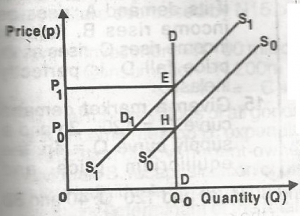
The diagram above explains the effect of government’s imposition of an indirect tax on a good characterized by zero price elasticity of demand.The tax imposed is borne
- A. totally by the consumer
- B. totally by the producer
- C. equally by both the consumer and the producer
- D. by the the government
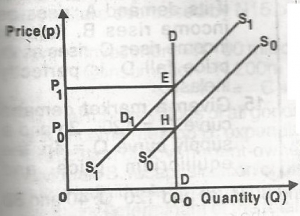
The diagram above explains the effect of government’s imposition of an indirect tax on a good characterized by zero price elasticity of demand. The total tax revenue is represented by
- A. P1EHPo
- B. PoHQo0
- C. P1EQo0O
- D. P1ED1Po
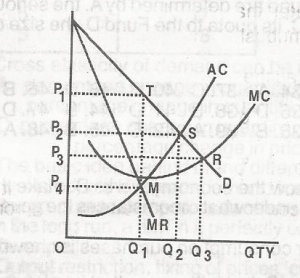
In the diagram above, the total revenue of the monopolist is given by the area
- A. OQ1MP2
- B. P4MTP1
- C. OQ1 TP1
- D. OQ2SP2

In this table, the marginal product of the 2nd worker and the average product of the 5th worker respectively are
- A. 23 and 20
- B. 22 and 19
- C. 14 and 19
- D. 11 and 20
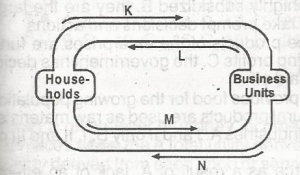
In the circular flow of income above, the direction of flow of payments for consumption purchases is shown by the arrow
- A. K
- B. L
- C. M
- D. N
The primary objective of all international economic organizations is to?
- A. ensure that third world countries get a better share of the world's resources
- B. promote international economic co-operation for the mutual benefit of all members
- C. enforce structural adjustment programmes on less developed countries
- D. encourage exports from the developed to the less developed countries
Foreign exchange rate in a free market economy is determined by?
- A. the government
- B. the Central Bank
- C. demand and supply
- D. commercial banks
The demand made on each other by the agriculture and industrial sector as the economy grows are reflected in?
- A. backward and forward linkages
- B. horizontal and vertical linkages
- C. vertical linkages
- D. functional linkages
An increasing population might be of economic benefit to a country if?
- A. the female population is greater than the male population
- B. the dependency ratio is increasing as the total population increases
- C. a continuosly higher proportion falls into working class category
- D. the rural and urban proportion ae balanced
Ajanka, a medical student entitled to an annual allowance of N6,000, decides to leave the university to take up a job where he earns N7,000 per annum. By this singular act, the national income level will?
- A. increase by N1,000
- B. decrease by N 7,000
- C. increase by N7,000
- D. increase by N 13,000
Which of the following is mostly used to determine the cost of living?
- A. Marginal changes in prices
- B. Consumer price index
- C. Prices of imported and exported commodities
- D. producer price index
Which of the following is the cheapest for the government in improving the welfare of its citizens?
- A. Subsidy
- B. Income supplement
- C. Donation to specific projects
- D. Wages increase
One method through which the Central Bank can restrict the commercial banks’ power of credit expansion is to?
- A. demand for increased special deposit
- B. decrease the cash ratio
- C. buy securities in the open market
- D. reduce the rate of interests at which banks borrow from it
A bank is said to be distressed when it?
- A. is unable to deal with the Central Bank
- B. has a low level of capital base
- C. has low level of deposits
- D. experiences serious liquidity crisis
The best method to curb inflation in Nigeria is to
- A. reduce importation of commodities
- B. increase the general level of production
- C. reduce the volume ofmoney supply
- D. set up price control boards
The sharp increase in the prices of most goods and services during the last quarter of 1994 in Nigeria were mainly due to?
- A. ban on importation of foreign goods
- B. population upsurge
- C. the introduction of value-added tax
- D. increase in transport costs
the Central Bank’s expansionary monetary policy is justified at a period?
- A. when the inflation rate is high and the economic is experiencing a boom
- B. of economic depression accompanied by low capacity utilization
- C. when trade unions are clamouring for higher wages
- D. when price of crude petroleum is rising
The most important goal of OPEC is to?
- A. present a united front for the purpose of raising the price of crude oil
- B. bring unity among the petroleum exporting states
- C. ensuring political stability among member states
- D. ensure that rules on quota producion are strictly followed
The major source of Nigeria’s foreign exchange is the export of?
- A. skilled manpower
- B. palm kernel and cocoa
- C. crude oil
- D. groundnuts and cotton
When compared with a labour-intensive industry, a capital-intensive industry employs more?
- A. workers than capital
- B. workers than machinery
- C. raw materials than capital
- D. machinery than workers