

Which of the following is not a consequence of hydrogen bubbles covering the copper plate of a primary cell?
- A. Polarization
- B. Local action
- C. Formation of hydrogen electrode
- D. Increase in the resistance of the cell
- E. Generation of less current by the cell


Calculate the rate at which energy is used up in the circuit illustrated by the diagram
- A. 0 W
- B. 2 W
- C. 4 W
- D. 8 W
- E. 16 W
A negatively charged rod is brought near the cap of a gold-leaf electroscope. The cap is earthed momentarily while the rod is near to it. The rod is then removed. Which of the following is correct?
- A. The cap will be positively charged and the negatively charged leaves will diverge
- B. The cap will be negatively charged and the positively charged leaves will diverge
- C. The cap and the leaves will be positively charged
- D. The cap and the leaves will be negatively charged.
- E. The leaves will not diverge because the cap has been earthed.
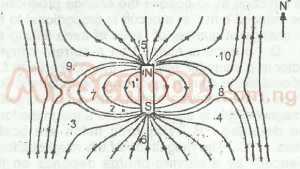
The diagram above shows the magnetic field around a bar magnet which has its N-pole pointing north. The neutral points in the field are likely to occur at
- A. 1 and 2
- B. 3 and 4
- C. 5 and 6
- D. 7 and 8
- E. 9 and 10
A pipe closed at one end is 1.0m long. The air in the pipe is set into vibration and a fundamental note of frequency 85Hz is produced. Calculate the velocity of sound in the air. (Neglect end correction).
- A. 340.0ms-1
- B. 33Oms-1
- C. 170ms-1
- D. 85.0ms-1
- E. 42.5ms-1
Which of the following statements is not true?
- A. Musical notes consist of the combination of sounds of regular frequency
- B. The combination of overtones produced by an instrument determines the quality of the sound
- C. the loudness of sound is determined by its frequency
- D. the pitch of a note depends on the frequency of vibration of the source
- E. Noise can be produced by a combination of sounds of irregular frequency
Which of the following waves are longitudinal waves? l. Ripples on the surface of water II. Waves produced by a tuning fork vibrating in air III. Light waves
IV. Waves produced by a flute
- A. I and II only
- B. I and III only
- C. II and III only
- D. II and IV only
- E. III and IV only
How far from a cliff should a boy stand in order to hear the echo of his clap 0.9s later? (Speed of sound in air = 330 ms-1)
- A. 36.67m
- B. 74.25m
- C. 148.50m
- D. 297.00
- E. 366.67m
Which of the following radiations have the highest frequency?
- A. Radio waves
- B. Light waves
- C. X-rays
- D. infra-red rays
- E. Ultraviolet rays
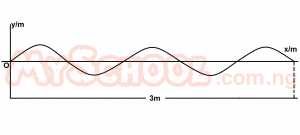
The diagram above shows a waveform in which energy is transferred from A to B in a time of 2.5 x 10⁻³s. Calculate the frequency of the wave
- A. 2.0 x 10³Hz
- B. 1.0 x 10³Hz
- C. 4.0 x 10⁻²Hz
- D. 1.0 x 10⁻³Hz
- E. 5.0 x 10⁴Hz.
The change of the direction of a wavefront as a result of a change in the velocity of the wave in another medium is called
- A. refraction
- B. reflection
- C. diffraction
- D. polarization
The angle of deviation of light of various colours passing through a glass prism decreases in the order of
- A. blue orange and red
- B. red, blue and orange
- C. blue, red and orange
- D. red, orange and blue
- E. orange, blue and red
Which of the following is used for controlling the amount of light entering the eye?
- A. Cornea
- B. Pupil
- C. Iris
- D. Optic nerve
- E. Ciliary muscle
When an astronomical telescope is in normal adjustment, the focal length of the objective lens is 50cm and that of the eyepiece is 2.5om. What is the distance between the lenses?
- A. 20.0cm
- B. 47.5cm
- C. 50.0cm
- D. 52.5cm
- E. 125.0cm.

The eye defect illustrated in the diagram above can be corrected by a
- A. convex mirror
- B. concave mirror
- C. diverging lens
- D. converging lens
- E. piano-converging lens
A real image of an object fom1ed by a converging lens of focal length 15cm is three times the size of the object. What is the distance of the object from the lens?
- A. 30cm
- B. 25cm
- C. 20cm
- D. 15cm
- E. 10cm
As an object is moved close to the focus of a converging lens from infinity its image I. moves closer to the lens II. moves away from the lens. III. Remains the same size. IV becomes smaller. Which of the statements above is/are correct?
- A. III and IV only
- B. I and III only
- C. IV only
- D. III only
- E. II only
The image of a pin formed by a diverging lens of focal length 10cm is 5cm from the lens. Calculate the distance of the pin from the lens
- A. -3.3cm
- B. 3.3cm
- C. 10.0cm
- D. 15.0cm
- E. 20.0cm

In an experiment to measure1 the focal length f of a converging lens object distances u and corresponding image distance were measured and 1/u plotted against 1/v to obtain the graph illustrated. How would f be determined from this graph?
- A. f= the slope of the graph
- B. f= the intercept on the 1/u axis
- C. f =the intercept on the 1/v axis
- D. f = reciprocal of the slope
- E. f = reciprocal of the intercept on either axes
Which of the following statements is not correct for a light ray passing through a rectangular glass block which is surrounded by air? It
- A. suffers a displacement at the point of emergence
- B. emerges parallel to the incident ray
- C. is partly reflected at the point of incidence
- D. is deviated at the point of emergence
- E. is reflected in the block
Images formed by a convex mirror are always
- A. inverted, real and diminished
- B. inverted, virtual and diminished
- C. erect, virtual and diminished
- D. erect, real and magnified
- E. erect, virtual and magnified