

In a ripple tank experiment, a vibrating plate is used to generate ripples in the water. If the distance between two successive troughs is 3.5 cm and the wave travels a distance of 31.5 cm in 1.5 s, calculate the frequency of the vibrator
- A. 3.0Hz
- B. 6.0Hz
- C. 12.0Hz
- D. 27.0Hz
- E. 73.5Hz

An object is placed between two mirrors which are inclined at an angle of 120° and facing each other. Determine the number of images observed in the two mirrors
- A. 1
- B. 2
- C. 3
- D. 4
- E. 5
A lens of focal length 15.0 cm forms an upright image four times the size of an object. Calculate the distance of the image from the lens
- A. 11.3cm
- B. 18.8 cm
- C. 37.5cm
- D. 45.0cm
- E. 75.0cm
In the normal use of a simple microscope, a person sees an
- A. inverted, virtual and magnified image
- B. erect, virtual and magnified image
- C. erect, real and magnified image
- D. inverted, real and magnified image
- E. inverted and real image the same size as the object.
The images formed by a diverging lens are always
- A. diminished, virtual and inverted
- B. diminished inverted and real
- C. diminished, virtual and erect
- D. magnified, virtual and erect
- E. magnified, real and inverted.
An image which cannot be formed on a screen is said to be
- A. inverted
- B. real
- C. virtual
- D. erect
- E. blurred
Longitudinal waves cannot be
- A. diffracted
- B. retracted
- C. polarized
- D. reflected
- E. superposed
Which of the following are correct of plane- polarized light? I. Plane polarization of light is the formation of hydrogen bubbles on the particles of light. II. Plane polarization of light is the splitting of light into its spectral components III. Plane-polarized light vibrates in one plane only. IV. Polarization is characteristic of transverse waves.
- A. I and II only
- B. I and IV only
- C. II and III only
- D. III and IV only
- E. I and III only
A gas has a volume of 546 cm3 at OºC. What is the volume of the gas at -100ºC if its pressure remains constant?
- A. 346cm3
- B. 446cm3
- C. 546cm3
- D. 646cm3
- E. 746 cm3.
A solid metal cube of side 10 cm is heated from
10oC to 60oC. lf the linear expansivity of the metal is 1.2 x 10⁵K-1, calculate the increase in its volume.
- A. 0.6cm3
- B. 1.2 cm3
- C. 1.8 cm3
- D. 3.6 cm3
- E. 6.0cm3.
The expansion of solids can be considered a disadvantage in the
- A. fire alarm system
- B. thermostat
- C. riveting of steel plates
- D. balance wheel of a watch
- E. fitting of wheels on rims.
If the temperature of water is gradually increased from 0o to 4oC, the density of the water within this range
- A. increases for a while and then decreases
- B. decreases for a while and then increases
- C. increases gradually
- D. decreases gradually
- E. remains the same
How far will a body move in 4 seconds if uniformly accelerated from rest at the rate of 2 ms-2?
- A. 32m
- B. 24m
- C. 16m
- D. 1.2m
- E. 5m
An object is projected with a velocity of 100 ms\(^{-1}\) from the ground level at an angle \(\theta\) to the vertical. If the total time of flight of the projectile is 10 s, calculate θ. (g = 10 ms\(^{-2}\)).
- A. 0o
- B. 30o
- C. 45o
- D. 60o
- E. 90o
A block of material of volume 2 X 10\(^{-5}\)m\(^3\) and density 2.5 x 10\(^3\) kgm\(^{-3}\) is suspended from a spring balance with half volume of the block immersed in water. What is the reading of the spring balance? (Density of water =1.0×10\(^3\) kg m\(^{-3}\) g = 10 ms\(^{-2}\)).
- A. 0.10N
- B. 0.25N
- C. 0.30N
- D. 0.40N
- E. 0.50N
A particle starts from rest and moves with a constant acceleration of 0.5 ms-2? Calculate the time taken by the particle to cover a distance of 25m.
- A. 25s
- B. 7.1s
- C. 10.0s
- D. 50.0s
- E. 100.0s.
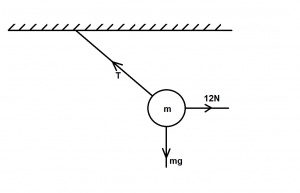
A body of mass m = 0.5 kg is suspended by a string and pulled by a horizontal force of 12N as shown in the diagram. Calculate the tension T in the String if the body is in equilibrium. [Take g as 10ms\(^{-1}\)]
- A. 7.0
- B. 10.9
- C. 12.5
- D. 13.0
- E. 17.0
A body of mass M1 moving with a velocity U collides with a stationary body of mass M2 and both move with a common velocity V lf linear momentum is conserved, which of the following expressions correctly represents V?
- A. M1 U/M1 + M2
- B. M2 U/M1 + M2
- C. M1 + M2/M1 U
- D. M1 - M2/M1 U
- E. M1 U/M1 - M2
A body timed 20 oscillations of a certain pendulum three times and obtained 44.3s, 45.5s and 45.7s respectively. Calculate the mean period of oscillation of the pendulum
- A. 0.13s
- B. 2.22s
- C. 2.26s
- D. 44.30s
- E. 45.17s
Which of the following is a derived unit?
- A. Ampere
- B. Kilogramme
- C. Second
- D. Ohm
- E. Kelvin
A body moves along a circular path with uniform angular speed of 0.6 rad s-1 and at a constant speed of 3.0ms-1. Calculate the acceleration of the body towards the centre of the circle.
- A. 25.0ms-2
- B. 5.4 ms-2
- C. 5.0ms-2
- D. 1.8 ms-2
- E. 0.2ms-2