

The half-life of a radioactive element is 5 Calculate its decay constant
- A. 0.113s-1
- B. 0.436 s-1
- C. 0.139 s-1
- D. 0.193 s-1.

The half-life of a radioactive substance is
- A. its average life time
- B. one-half the value of its decay constant.
- C. the length of time needed by the substance to decay completely
- D. the length of time during which the activity of the substance reduces by 50%.
A metal has work function of 4.375 eV Calculate its threshold frequency. (h = 6.6 x 10⁻³⁴Js; 1eV = 1.6 x 10⁻¹⁹J)
- A. 2.01 X 10¹⁵Hz
- B. 1.06x10¹⁵Hz
- C. 6.30 x 10¹⁴Hz
- D. 1.60 x 10¹⁴Hz
I. All elements emit and absorb characteristic spectra. II. Spectral analysis is an important method of identifying environmental pollutants. III. The chemical composition of stars could be determined using spectral analysis. Which of the statements above are correct?
- A. I, II and III
- B. II and III only
- C. I and III only
- D. I and II only
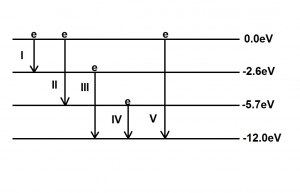
Which of the transitions will produce the emission of highest frequency?
- A. V
- B. IV
- C. III
- D. II
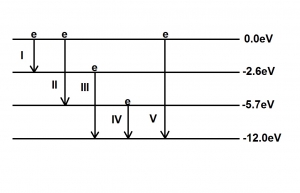
The diagram above illustrates the energy transitions of five electrons of an atom. Which of the transitions will produce the emission of longest wavelength?
- A. I
- B. II
- C. III
- D. IV
Bohr’s atomic model proves most successful for the explanation of the. I. structure of the hydrogen atom; II. line spectra of the hydrogen atom; III. Multi-electron atoms. Which of the statements above is/are correct?
- A. I only
- B. II only
- C. I and II only
- D. I and III only
A point charge of magnitude 2μC is moved through a distance of 0.02 m against uniform field of intensity 25 Vm-1 Calculate the work done on the charge
- A. 5.0 x 10⁶J
- B. 1.0 x10⁻⁶J
- C. 5.0 x10⁻⁷J
- D. 1.0 x 10⁻²J
A 10 Ω coil takes 21 s to melt 10g of ice at 0ºC. Assuming no heat losses, determine the current in the coil. (Specific latent heat of fusion of ice = 336 Jg\(^{-1}\))
- A. 16A
- B. 5A
- C. 4A
- D. 3A
In a uniform electric field, the magnitude of the force on a charge of 0.2 C is 4N. Calculate the electric field intensity
- A. 20 N C-1
- B. 8 N C-1
- C. 5 N C-1
- D. 2 N C-1
The voltage and current in the primary of a transformer are 200V and 2Arespectively. lf the transformer is used to light ten 12 V, 30 W bulbs, calculate its efficiency.
- A. 100%
- B. 90%
- C. 75%
- D. 50%
Magnetic flux density is defined as the
- A. total number of magnetic lines of force surrounding a magnet
- B. number of magnetic lines of force per unit area normal to the magnetic field
- C. strength of the magnetic field surrounding a current-carrying conductor
- D. magnetic force exerted on a unit magnetic pole
A resistance wire of length 2 m and of uniform cross-sectional area 5.0 x 10⁻⁷ m2 has a resistance of 2.2 Ω Calculate its resistivity
- A. 1.8 x 10⁻⁷Ωm
- B. 5.5 x 10⁻⁷Ωm
- C. 1.8 x 10⁻⁷Ωm
- D. 5.8 x 10⁷Ωm
The parts of a bar magnet at which the magnetic effect is strongest are called the
- A. poles
- B. neutral points
- C. magnetic declinations
- D. magnetic meridians
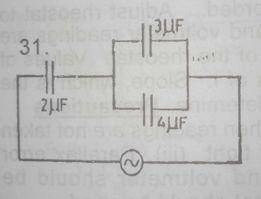
Using the diagram above, calculate the effective capacitance of the circuit
- A. 1.56μf
- B. 3.00μF
- C. 3.71μF
- D. 9.00μF
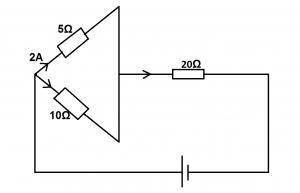
Using the data on the diagram above, calculate the potential difference across the 20- Ω resistor. (Neglect the internal resistance of the cell)
- A. 5V
- B. 10V
- C. 20V
- D. 60V
Thunder is usually heard some seconds after lightning is observed because
- A. the human eye is more sensitive to light than the ear to sound
- B. sound and light travel in different media
- C. thunder occurs after lightning
- D. light travels faster than sound
If the position of resonance in a resonance tube is 16.50cm from open end of the tube, calculate the distance from the open end to the next position where resonance occurs. (Neglect end-correction)
- A. 24.75cm
- B. 33.00cm
- C. 41.25cm
- D. 49.50cm
ln order to obtain a sound note of a high pitch from a wire stretched by a constant tension, the wire must be
- A. short and thick
- B. short and thin
- C. long and thick
- D. long and thin
The amplitude of a wave is the
- A. distance between two successive troughs of the wave
- B. separation of two adjacent particles vibrating in phase
- C. maximum displacement of the wave particle from the equilibrium position
- D. distance travelled by a wave in a complete cycle of its motion
Which of the following statements is not correct about long sight?
- A. A Iong-sighted person can see distant objects clearly
- B. ight from a nearby object is focused behind the retina.
- C. The eyeball is too short
- D. The defect is corrected by using a diverging lens.