

The real image of an object formed by a converging lens of focal length 15cm, is three times the size of the object. Calculate the object distance
- A. 60cm
- B. 30cm
- C. 20cm
- D. 15cm

The refractive index of glass for yellow light is greater than that for red light because yellow light
- A. has a greater amplitude than red light
- B. is more intense than red light
- C. travels more slowly than red light
- D. deviates less than red light
The image of an object is located 6cm behind a convex mirror. If its magnification is 0.6, calculate the focal length of the mirror
- A. 3.75cm
- B. 6.60cm
- C. 10.00cm
- D. -15.00cm
The air column in a resonance tube is set into resonance by a vibrating tuning fork. The resultant waves in the air column will be
- A. mechanical and transverse
- B. progressive and longitudinal
- C. stationary and transverse
- D. stationary and longitudinal.
A ray of light is incident on ‘a plane mirror at an angle of 20o. This mirror is rotated through, twice this angle, In this new position the angle between the incident ray and the reflected ray is
- A. 20o
- B. 40o
- C. 80o
- D. 120o.
Calculate the power rating of an immersion heater used for 10 minutes to increase the temperature of 10kg of water by 15K. (Specific heat capacity of water = 4200 J l
- A. 1,050W
- B. 16,800W
- C. 18,060W
- D. 20,160W
Which of the following statements about evaporation is not correct?
- A. The rate of evaporation of a liquid varies with temperature
- B. The molecules of an evaporating liquid have an average speed
- C. Evaporation occurs when faster molecules escape from the surface of a liquid
- D. Evaporation takes place inside a liquid.
Calculate the heat energy required to change 0.1kg of ice at 0oC to water boiling at 100oC. (Specific heat capacity of water = 4200 J kg-1K-1) (Specific latent heat of fusion of ice = 336,000 J kg-1)
- A. 75,600J
- B. 336,000J
- C. 340,200J
- D. 378,000J.
Which of the following statements is not correct?
- A. A sea breeze is due to convection in air
- B. Cotton materials are better than woollen ones for use in hot weather
- C. Convectional currents play an important role in the cooling of the engine of a motor car
- D. The vacuum space in a flask helps to reduce heat loss by radiation.
The temperature of a piece of metal of mass 9 g is raised from 10oC to 110oC when it absorbs 108J of heat energy. Determine the specific heat capacity of the metal in J kg-1K-1
- A. 1.2
- B. 12.0
- C. 120.0
- D. 1200.0
The heat capacity of a substance is the energy
- A. required to raise the temperature of a unit mass of the substance by one degree.
- B. required to raise the temperature of the substance by one degree
- C. absorbed by the substance at constant temperature
- D. lost by a unit mass of the substance.
An iron rod of length 50m and at a temperature of 60oC is heated to 70oC. Calculate its new length. (Linear expansivity of iron = 1.2 x 10⁻⁵K-1)
- A. 50.006m
- B. 50.060m
- C. 51.600m
- D. 51.200m
Iron at 30oC feels colder to the hand than wood at 28oC because
- A. their linear expansivities are not equal.
- B. the temperature of the iron is higher than that of the wood
- C. iron is a better radiator of heat than wood
- D. iron conducts heat more quickly from the hand than wood
The ice point of an ungraduated mercury-in-glass thermometer is X, while its steam point is 90o. This thermometer reads 60o when the true temperature is 40oC Calculate the value of X.
- A. 60o
- B. 48o
- C. 40o
- D. 30o
A trolley of mass 4kg moving on a smooth horizontal platform with a speed of 1.0ms-1 collides perfectly with a stationary trolley of the same mass on the same platform. Calculate the total momentum of the two trolleys immediately after the collision.
- A. 0.5Ns
- B. 1.0Ns
- C. 4.0Ns
- D. 8.0Ns
A pendulum bob executing simple harmonic motion has 2cm and 12Hz as amplitude and frequency respectively. Calculate the period of the motion.
- A. 2.00s
- B. 0.83s
- C. 0.08s
- D. 0.60s
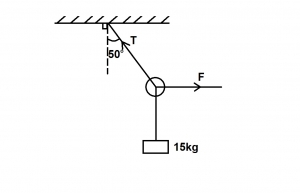
A 15kg mass, suspended from a ceiling, is pulled aside with a horizontal force, F, as shown in the diagram above. Calculate the value of the tension, T. (g = 10ms-2)
- A. 300.0N
- B. 173.2N
- C. 30.0N
- D. 17.3N
If the force of attraction between the sun and the 1 planets is removed; the planets will
- A. fall towards the sun
- B. scatter and stop moving
- C. continue to move at tangent to their original orbits
- D. continue to move perpendicular to their original orbits. '
A stone of mass 0.7kg is projected vertically , upwards with a speed of 5ms-1. Calculate the maximum height reached. (Take g as 10ms-2 and neglect air resistance)
- A. 1.00m
- B. 1.25m
- C. 1.50m
- D. 3.75m
The time rate of change of displacement is known as
- A. speed
- B. velocity
- C. impulse
- D. acceleration
A motorcyclist, passing a road junction, moves due west for 8 s at a uniform speed of 5ms-1. He then moves due north for another 6 s with the same speed. At the end of the 6s his displacement from the road junction is 50m in the direction of
- A. N53oE
- B. N37oE
- C. N53oW
- D. N37oW