


- Measure and record the e.m.f. of the accumulator provided.
- Connect a circuit as shown in the diagram. S is a standard resistor and R is a resistance box.
- With R = 0\(\Omega\), close the key K. Read and record the ammeter reading I. Evaluate 1\(^{-1}\).
- Repeat the procedure for R=1,2, 3, 4, and 5\(\Omega\). Tabulate your readings.
- Plot a graph of R on the vertical axis and 1\(^{-1}\) on the horizontal axis, starting both axis from the origin (0,0).
- Determine the slope s of the graph and find the intercept C on the vertical axis.
- State two precautions taken to ensure accurate results.
(b)i. State two advantages of a lead-acid accumulator over a Leclanche cell.
ii. A parallel combination of 3\(\Omega\) and 4\(\Omega\) resistors is connected in series with a resistor of 4\(\Omega\) and a battery of negligible internal resistance. Calculate the effective resistance in the circuit.

- Fix a metre rule on the bench with the graduated face up.
- Place the illuminated object at the zero end of the rule and the screen at the other end as illustrated in the diagram above.
- Measure and record D, the distance between the object and the screen. Evaluate D\(^{2}\).
- Place and move the converging lens between the illuminated object and the screen until a diminished sharp image of the object is formed on the screen. Read and record the position, X\(_{1}\), of the lens. From this position, move the lens towards the object until another sharp image of the object is formed on the screen. Read and record the new position x\(_{2}\), of the lens.
- Evaluate and record L (x\(_{1}\) – x\(_{2}\)), L\(^{2}\)) and (D\(^{2}\) – L\(^{2}\))
- Repeat the procedure for D = 90, 80, 70 and 60 cm. In each case, evaluate, L L\(^{2}\) and (D\(^{2}\) – L\(^{2}\)). Tabulate your readings.
- Plot a graph of D\(^{2}\) – L\(^{2}\) on the vertical axis against D on the horizontal axis.
- Determine the slope, S, of the graph and evaluate K = \(\frac{s}{4}\). State two precautions taken to ensure accurate results.
(b)i. Distinguish between a real image and a virtual image.
Draw a ray diagram to show how a converging lens may be used to form a real diminished image of an object.

- Using the spring balance provided, determine the weight of object of mass M = 5.0g. Record this weight as W\(_{1}\).
- Determine the weight of the object when completely immersed in water contained in a beaker as shown in the diagram. Record the weight as W\(_{2}\)
- Determine the weight of the object when it is completely immersed in the liquid labelled ‘L’. Record the weight as W\(_{3}\). Evaluate, u = (W\(_{1}\) -W\(_{3}\)) and v = (W\(_{1}\) – W\(_{3}\)).
- Repeat the procedure with the objects of masses M = 10, 15, 20, and 25g. In each case, evaluate u = (W\(_{1}\) – W\(_{3}\)) and v = (W\(_{1}\) – W\(_{3}\)) on the vertical axis against u = (W\(_{1}\) – W\(_{2}\) on the horizontal axis.
- Determine the slope, s, of the graph. (vii) State two precautions taken to ensure accurate results.
(b)i. A piece of brass of mass 20.0g is hung on a spring balance from a rigid support and completely immersed in kerosine of density 8.0 x 10\(^{2}\)kg m\(^{-3}\). Determine the reading on the spring balance. [g= 10ms\(^{-2}\)], density of brass = 8.0 x 10\(^{3}\) kg m\(^{-3}\) J
ii. State Archimede’s principle and the law of floatation.
(a)(1) State the energy transformations which take place during the operation of a modern x-ray tube.
(ii) Distinguish between hard and soft x-rays.
(iii) State three uses of x-rays.
(iv) Mention one hazard of over-exposure to x-rays in a radiological laboratory, and indicate any two safety precautions.
(b) A possible fusion reaction is \(^2_1 H + ^2_1 H \to ^3_1H + ^1_1H + Q\)
where Q is the energy released as a result of the reaction. If Q = 4.03 MeV, calculate the atomic mass of \(^3_1H\) in atomic mass units. (\(^2_1 H = 2.01410 U; ^1_1H = 1.00783 U; 1U = 931 MeV\))
(a) Define the following terms:
(i) Electric field intensity
(ii) Electric potential
(b) The diagram below illustrates two collinear electric charges of magnitudes + Q and -Q. The charges are equidistant from a point P at which a rest charge is placed.
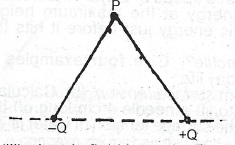
Copy the diagram and use arrows to indicate, from the point P, the direction of the;
(i) electric force F\(_1\) due to + Q.
(ii) electric force F\(_2\) due to -Q.
(iii) electric field intensity E.
(c) What is meant by dielectric substance?
(ii) List the factors which determine the capacitance of a parallel plate capacitor and state the effect each of them has on the capacitance.The diagram above represents a section of a circuit. Calculate the effective capacitance in the section.
(iii)
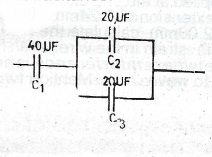
The diagram above represents a section of a circuit. Calculate the effective capacitance in the section.
(a)(i) State the laws of refraction of light.
(ii) Describe an experiment to determine the refractive index, n, of the material of an equilaleral triangular glass prism using the minimum deviation method.
(b) A rectangular glass prism of thickness 12cm is placed on a mark on a piece of paper resting on a horizontal bench:
(i) Draw a ray diagram to show the apparent position of the mark in the glass prism.
(ii) If the refractive-index of the material of the prism is 1.5, calculate the apparent displacement of the mark.
(a)(i) Mention two modes of heat transfer other than convection.
(ii) Explain land and sea breezes.
(b) An iron rod of length 30cm is heated through 50 kelvin. Calculate its increase in length. (linear expansivity of iron = 1.2 x 10\(^{-5}\)K\(^{-1}\)
(c) An electric heater immersed in some water raises the temperature of the water from 40°C to 100°C in 6 minutes. After another 25 minutes, it is noticed that half the water has boiled away. Neglecting heat losses to the surrounding, calculate the specific latent heat of vaporisation of water.
(a)(i) Define the term linear momentum.
(ii) State the law of conservation of linear momentum.
(b) A ball P of mass 0.25 kg, loses one-third of its velocity when it makes a head on collision with an identical ball Q at rest. After the collision, Q moves off with a speed of 2ms\(^{-1}\) in the original direction of P. Calculate the initial velocity of R
(c)(i) State Newton’s second law of motion.
(ii) Show that F = ma where F is the magnitude of the force acting on a body of mass m to give it an acceleration of magnitude a.
(iii) The engine of a vehicle moves it forward with a force of 9600 N against a resistive force of 2200 N. If the mass of the vehicle is 3400 kg, calculate the acceleration produced.
An electron of mass 9. 1 x 10\(^{-31}\) kg moves with a velocity of 4.2 x 10 ms\(^{-1}\) between the cathode and anode of an x-ray tube. Calculate the wavelength. (Take Planck’s constant h = 6.6 x 10\(^{-34}\) J S)
During the electrolysis of copper (II) tetraoxosulphate (VI) solution, a steady current of 4.0 x 10\(^2\) A flowing for one hour liberated 0.48 g of copper. Calculate the mass of copper liberated by one coulomb of charge.
(a) Define angle of contact
(b) Draw sketches to show angles of contact for a capillary tube dipped vertically in (i) water; (ii) mercury.
(a) Differentiate between interference and polarisation as applied to waves.
(b) Mention two uses of polaroids
A force of 40 N is applied at the end of a wire 4m long and produces an extension of 0.24mm. If the diameter of the wire is 2.00mm, calculate the;
(i) stress on the wire; (ii) strain in the wire.
State any three properties of matter which are common to all substances.
a) Define the term surface tension
(b) Calculate the force required to lift a needle 4cm long off the surface of water if the surface tension of water is 7.3 x 10\(^{-4}\) NM\(^{-1}\)
What is a projectile? Give four examples of projectiles in everyday life
A body of mass 0.6kg is thrown vertically upward from the ground with a speed of 20ms\(^{-2}\). Calculate its;
(i) potential energy at the maximum height reached.
(ii) kinetic energy just before it hits the ground.
The duality of matter implies that matter
- A. exists as a particle of dual composition
- B. has momentum and energy
- C. has both wave and particle properties
- D. is made up of dual materials

In a nuclear reactor, electricity can be generated through the following processes. Arrange the processes in the correct order. i. The steam is used to drive turbines. ii. The heat energy released is removed by passing water through the reactor. iii. The turbines in turn generate electricity. iv. The water then passes through some form of heat exchanger to produce steam
- A. ii, iv, i and iii
- B. i, ii, iii and iv
- C. iii, i, iv and ii
- D. iv, i, iii and ii
The nucleon number and the proton number of a neutral atom of an element are 23 and 11 respectively. How many neutrons are present in the atom?
- A. 11
- B. 12
- C. 23
- D. 34