

(a) Define gravitational field intensity
(b) In an experiment to determine the acceleration of free-fall due to gravity, g, using a simple pendulum of length I, six different values of I were used to obtain six corresponding values of period T. If a graph of I along the vertical axis is plotted against T\(^2\) on the horizontal axis;
(i) make a sketch to show the nature of the graph,
(ii) write down the equation that relates T, I and g hence obtain an expression for the slope of the graph
(iii) given that the slope of the graph is 0.25, determine the value for g [Take \(\pi\) = 3.142]
(c) A stone, thrown horizontally from the top of a vertical wall with a velocity of 15 ms\(^{-1}\), hits the horizontal ground at a point 45m from the base of the wall. Calculate the
(i) times of light of the stone
(ii) height of the wall [g = 10ms\(^{-2}\)]
Explanation
(a) The gravitational field intensity at any point on the earth's field is the gravitational force acting on a unit mass at that point
(b)(i)
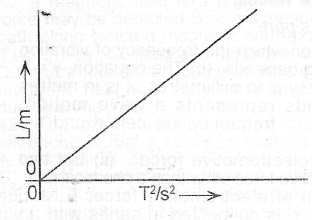
(ii) A simple Pendulum of length L, swinging in a vertical plane at a small angle of displacement has a period T given as
\(T = 2 \pi \sqrt{\frac{L}{g}}\)
\(T^{2} = \frac{4 \pi^2L}{g}\)
L = \(\frac{gT^2}{4 \pi^2}\)
Slope S of the graph I against \(T^2 = \frac{g}{4 \pi^2}\)
(iii) g = 4\(\pi^2\)S = 4(3.142)\(^2\) x 0.25 = 9.87m/s\(^{2}\)
(c)(i) Time t = \(\frac{distance}{speed} = \frac{45}{15}\) = 3(s)
(ii) Height h = \(\frac{1}{2} gt^2 = \frac{1}{2} \times 10 \times 3^3 = 45m\)