

(a)(i) Name and explain the common defects of a primary cell.
(ii) State two advantages of a secondary cell over a primary cell.
(b) Draw a labelled diagram to show the essential parts of a dry leclanche cell.
(c)(i) Explain why six accumulators each of e.m.f 2V connected in series can be used to start the engine of a car whereas eight dry cells each of e.m.f 1.5 V connected in series cannot be used.
(ii) Name the materials used for the positive terminal, the negative terminal and the electrolyte in a
I. leclanche cell;
II. charged lead acid accumulator.
Explanation
(a)(i) Primary cell defects:
— Polarization
— Local action Polarization
— This is due to hydrogen bubbles covering the positive electrode (copper plate). Local action
— This is due to the use of impure zinc or the gradual wearing away of the negative electrode zinc plate.
(ii) Advantages of secondary cell over a primary cell:
— a secondary cell can be recharged while primary cell cannot.
— secondary cell can supply current for a longer period while the primary cell has a short life-span.
(b)
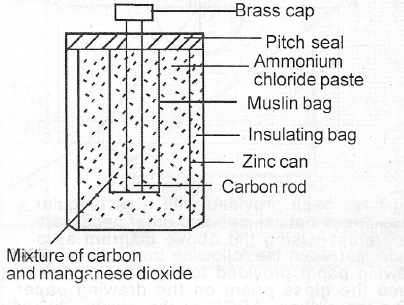
(c)(i) The internal resistance of the dry cells is much larger than that of the accumulators, hence accumulators will produce larger currents needed to start the engine.
(ii)
| Positive terminal | Negative terminal | Electrolyte | |
| Leclanche cell | Carbon rod | Zinc rod | Ammonium chloride (NH\(_4\) |
|
charged lead acid accumulator |
Lead (IV) oxide or Lead peroxide | Lead |
Lead Tetra oxo-sulphate (VI) acid (H\(_2\)SO\(_4\)) |