

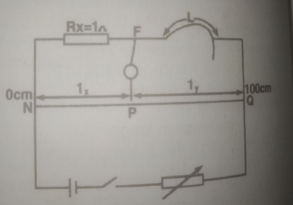
You are provided with two resistance wires labeled A and B, a1\(\Omega\) standard resistor Rx, and other necessary apparatus.
- Connect R\(_{x}\) in the left-hand gap of the metre bridge, a length L= 100cm of wire A in the right-hand gap, and the other apparatus as shown in the diagram above.
- Determine and record the balance point P on the bridge wire NQ.
- Measure and record l\(_{x}\) = NP and l\(_{y}\) = PQ.
- Evaluate R\(_{1}\) = \(\frac{I_{y}}{L_{x}}\) = R\(_{x}\)
- Repeat the procedure for four other values of L= 95, 85, 75 and 65cm. In each case, determine and record the balance point P and the length l\(_{x}\) and l\(_{y}\). Also, evaluate R\(_{1}\).
- Repeat the experiment with the second wire B. Obtain the balance points P and the values of and l\(_{x}\) and l\(_{y}\).
- Evaluate R\(_{1}\) = \(\frac{I_{y}}{L_{x}}\) = R\(_{x}\) in each case. Tabulate your readings.
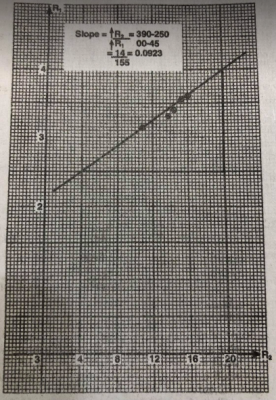
- Plot a graph of R\(_{2}\) on the vertical axis against R\(_{1}\) on the horizontal axis.
- Determine the slope, s, of the graph.
- Evaluate k = \(\sqrt s \).
- State two precautions taken to obtain accurate results.
(b)i. State two advantages of using a potentiometer over a voltmeter for measuring the potential difference.
ii. Define the internal resistance of a cell.
Explanation
| L(cm) | Lx(cm) | Ly(cm) | R\(_{1}\)=Ly. L x R | Lx\(_{1}\) | Ly\(_{1}\) | R\(_{2}\),(Ly/Lx)Rx |
| 100 | 5.2 | 95.0 | 18.3 | 21.5 | 78.3 | 3.64 |
| 95 | 6.0 | 94.0 | 15.7 | 22.6 | 77.8 | 3.44 |
| 85 | 6.5 | 94.0 | 14.5 | 22.8 | 76.4 | 3.35 |
| 75 | 7.8 | 93.1 | 12.0 | 23.4 | 75.6 | 3.23 |
| 65 | 8.5 | 95.5 | 11.2 | 24.3 | 75.2 | 3.10 |
k = s
s = 0.0903
k = 0.0903 = 0.3005
Precautions: I
- ensured keys were removed when not taking readings.
- ensured tight connections/clean terminals.
- avoided parallax errors in reading meter rule.
- ensured jockey did not scratch the resistance wire.
- avoided zero error of meter rule noted and corrected.
(b)i. Advantages of the potentiometer over the voltmeter
- High accuracy
- Null deflection (does not draw current at balance point).
- Range can be increased as required.
- No friction in moving parts.
ii. The internal resistance of a cell is the opposition to the current flow through (the electrolyte of) the cell.