

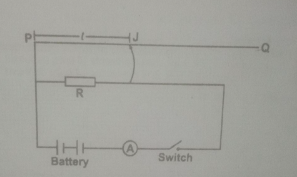
1. Connect the circuit as shown in the diagram above. PQ is a potentiometer wire 100 cm long and R is a standard resistor of 5\(\Omega\).
2. With the jockey J not making contact with PQ, close the switch. Read and record the ammeter reading I. Open the switch.
3. Use the jockey to make contact with PQ at the 20cm mark such that PJ = I = 20 cm. Close the switch, read and record the value I\(_{i}\) of the ammeter. Evaluate I\(^{-1}\).
4. Repeat the procedure for other values of I = 35, 50, 65, and 80 cm. In each case, determine the corresponding values of I\(_{i}\), and I\(^{-1}\). Tabulate your readings.
- Plot a graph of I\(^{i}\) on the vertical axis and I\(_{i}\), on the horizontal axis, starting both axes from the origin (0, 0).
- From your graph deduce the value, of I\(_{o}\) of I\(_{i}\), when I\(^{-1}\)= 0.
- Evaluate I\(_{o}\)e
- State two precautions taken to ensure accurate results.
(b)) Define the e. m.f. of a battery
ii. A cell X e.m.f. 1.00 V is balanced by a length of 40.0 cm on a potentiometer wire. Another cell Y is balanced by a length of 60.0 cm on the same wire. Calculate the e.m.f. of Y.

- You are provided with a measuring cylinder, two different tins labeled C and D, a thermometer, and other necessary materials.
- Use the measuring cylinder provided to measure 100 cm of water and pour it into the tin label.
- Heat the water in the tin almost to boiling (90°C).
- Remove the tin and place it on a cork or wooden stand.
- Insert the thermometer into the tin and record the temperature of the water every minute starting from 85°C until the temperature falls to 60°C.
- Repeat the experiment with the tin labeled D using exactly the same volume of water and temperature range. Tabulate your readings.
- On the same graph sheet and using the same axis and scales, plot two graphs of temperature on the vertical axis and time on the horizontal axis from the readings obtained using tins C and D.
- Label the graphs appropriately as C and D to correspond with the tins used.
- From each graph, read off the time taken to cool from 85°C to 65°C.
- State two precautions taken to ensure accurate results.
(b)i. Explain how heat losses by radiation and convection are minimized in a vacuum flask.
ii. State four factors that affect the rate of evaporation of a liquid in an open container.

- You are provided with two meter rules and other necessary apparatus.
- Place one of the rules on a knife edge and determine its centre of gravity C. Mark this pos with a piece of chalk.
- Read and record the mass M\(_{R}\) of the metre rule written on the reverse side of it.
- Attach the mass M= 100g firmly to the rule AB at C using sellotape.
- Suspend the metre rule by two parallel threads of length h = 40 cm each at the 10 cm marks. Ensure that the graduated face to the metre rule is facing upwards.
- Set the rule AB into a small angular oscillation about the vertical axis through its centre of gravity.
- Determine the time, t for 20 complete oscillations. Evaluate the period T and T\(^{2}\)
- Read and record the value of d in meters.
- Keeping d constant throughout the experiment, repeat the procedure for other values of h = 50, 60, 70, and 80 cm. In each case determine the corresponding values of f T and T. Tabulate your reading. (x) Plot a graph of T on the vertical axis and h on the horizontal axis.
- Determine the slope S, of the graph. Evaluate k =s, where Q =2 S, Q 250P
- State two precautions taken to ensure accurate results.
(b)i. Define the term couple as it relates to rotational or oscillatory systems.
ii. Give two practical application of a couple in everyday life.
Give three observations in support of de Broglie’s assumption that moving particles behave like waves
(a) Briefly explain the following terms:
(i) emission line spectra;
(ii) line absorption spectra.
(b) Draw a labeled diagram showing the structure of a simple type of photocell and explain its mode of operation.
(c) State two
(i) reasons to show that x-rays are waves;
(ii) uses of x-rays other than in medicine.
(d) An electron jumps from an energy level of -1.6eV to one of -1.4 eV in an atom. Calculate the energy and wavelength of the emitted radiation. [ h = 6.6 x 10\(^{-34}\) Js; c = 3.00 x 10\(^8\) ms\(^{-1}\); eV = 1.6 x 10\(^{-19}\) J ]
(a) State two essential differences between a moving coil galvanometer and a d.c. generator.
(b) Explain the term eddy currents and state two devices in which the currents are applied.
(c) State the principle on which the potentiometer is based when it is functioning.
(d) A source of e.m.f. 110 V and frequency 60Hz is connected to a resistor, an inductor and a capacitor in series. When the current in the capacitor is 2A, the potential differences across the resistor is 80 V and that across the inductor is 40 V. Draw the vector diagram of the potential differences across the inductor, the capacitor and the resistor.
Calculate the:
(i) potential difference across the capacitor;
(ii) capacitance of the capacitor;
(iii) inductance of the inductor. [π = 3.14]
(a) State two differences between a sound wave and a radio wave.
(b) Explain why a vibrating tuning fork sounds louder when its stem is pressed against a table top than when held in air.
(c)State two conditions necessary for the:
- production of stationary wave in a medium;
- formation of interference wave patterns;
- occurrence of total internal reflection of a wave.
(d) A ray of light is incident on one face of an equilateral glass prism.
- Draw a ray diagram to show the path of the ray through the prism.
- Calculate the refractive index of the glass if the angle of minimum deviation is 41\(^o\).
(a) Explain why it is not advisable to sterilize a clinical thermometer in boiling water at normal atmospheric pressure.
(b) State the effect of an increase in pressure on the
(i) boiling point; and
(ii) melting point of water.
(c) Diagram:

The graph shown above is that of the saturated vapour pressure (s.v.p.) of water against temperature.
Pure water is known to boil at 100\(^o\)C and at an atmospheric pressure of 760 mmHg. What general conclusion can be drawn from the information given above?
d) A thread of mercury of length 20 cm is used to trap some air in a capillary tube with uniform cross-sectional area and closed at one end. With the tube vertical and the open end uppermost, the length of the trapped air column is 15cm. Calculate the length of the air column when the tube is held:
i) horizontally;
ii) vertically with the open end underneath. [Atmospheric pressure = 76 cmHg ]
a) Given a retort stand and clamp, a stout pin, a simple pendulum and a pencil, describe how you would use these apparatus to determine the centre of gravity of an irregularly shaped piece of cardboard of a moderate size.
(b) Using a suitable diagram, explain how the following can be obtained from a velocity-time graph:
(i) acceleration;
(ii) total distance covered.
(c ) A body at rest is given an initial uniform acceleration of 6.0 ms\(^{-2}\) for 20s after which the acceleration is reduced to 4.0 ms\(^{-2}\) for the next 10s.
The body maintains the speed attained for 30s.
Draw the velocity-time graph of the motion using the information given above. From the graph, calculate the:
- maximum speed attained during the motion;
- total distance traveled during the first 30 s;
- average speed during the same time interval as in (ii) above.
a) List two properties of cathode rays.
(b) Explain how the intensity and energy of cathode rays may be increased
a) Define diffusion.
(b) State two applications of electrical conduction through gases.
(a) State Faraday’s second law of electrolysis.
(b) An electric charge of 9.6 x 10\(^4\) C liberates 1 mole of substance containing 6.0 x 10\(^{23}\) atoms. Determine the value of the electronic charge
(a) Explain what is meant by cations
(b) Draw and label an electrolytic cell
A particle is projected horizontally at 15ms\(^{-1}\) from a height of 20m.
Calculate the horizontal distance covered by the particle just before hitting the ground.
[g = 10 ms\(^{-2}\)]
A particle is dropped from a vertical height h and falls freely for a time t. With the aid of a sketch, explain how h varies with
(a) t;
(b) t\(^2\).
An electron of mass 9.1 x 10⁻³¹ kg moves with a speed of 107ms-1. Calculate the wavelength of the associates wave[h = 6.6 x 10⁻³⁴Js]
- A. 9.0 x 10⁻²⁴m
- B. 4.55 x 10⁻¹⁷m
- C. 7.25 x 10⁻¹¹m
- D. 6.20 x 10⁻⁸m

The main difference between between x-rays and \(\gamma-rays\) lies in their
- A. ionizing ability
- B. absorption rate
- C. mode of production
- D. mode of propagation
Two isotopes of uranium are designed as \(^{238}U\) and \(^{235}U\). The numbers 238 and 235 represent their
- A. atomic numbers
- B. nucleon numbers
- C. proton numbers
- D. neutron numbers