

(a) (i) What is a machine?
(ii) State two uses of gears.
(iii) Define the velocity ratio for a pair of gear wheels.
(iv) How can the mechanical advantage of a gear system be increased?
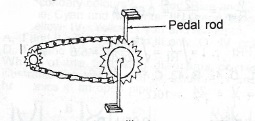
The diagram above illustrates the gears system of a bicycle.
(i) Determine its velocity ratio.
(ii) If the bicycle has an efficiency of 90%, calculate the effort required to overcome a load of 70N.
(iii) Why is the calculated effort less than the actual effort required?
Explanation
(a)(i) A machine is a device in which an effort applied at one end is used to overcome a load at another point. Machine makes work easier.
(ii) Uses of gears are: - to change speed to change direction of motion
- to magnify force.
(iii) Velocity ratio of a gear wheel is the ratio of number of teeth on driven wheel to number of teeth on driving wheel OR
Velocity ratio = \(\frac{\text{Time rate of revolution/speed/radius of driven wheel}}{\text{Time rate of revolution/speed/radius of driving wheel}}\)
(iv) To increase the mechanical advantage, the driving gear is made smaller with fewer teeth than the driven gear.
(b) Number of teeth on driven gear = 12.
Number of teeth on driving gear = 18.
(i) V.R. = \(\frac{\text{no. of teeth on driven gear}}{\text{no. of teeth on driving gear}}\)
= \(\frac{12}{8} = \frac{2}{3}\)
(ii) Efficiency - \(\frac{M.A}{V.R}\) x 100% = x 100%
= \(\frac{L/E}{V.R}\) x 100%
90 = \(\frac{70/E}{2/3}\) x 100%
(iii) This is due to: - Friction between the tyres and load.
- Friction between chain and gear.