

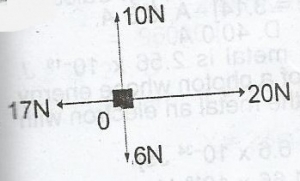
Four co-planar forces of magnitudes 10N, 17N, 6N and 20N act at point O as shown in the above diagram. Determine the magnitude of the resultant force
- A. 53.N
- B. 21.0N
- C. 7.0N
- D. 5.0N

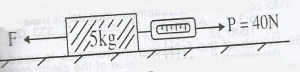
A block of wood of mass 5kg is pulled on a platform by a force of 40N as illustrated in the diagram above. If the frictional force, F experienced by the block is 12N, calculate the magnitude of the acceleration of the acceleration of the block
- A. 2.4ms-2
- B. 5.6ms-2
- C. 8.0ms-2
- D. 2.4ms2
Which of the following phenomena supports the theory that waves have a particle nature?
- A. electron diffraction
- B. photoelectric effect
- C. diffraction of light
- D. x-ray interference
Which of the following statements about the use of radioisotopes is not correct? They are used to
- A. induce mutations in plants and animals to obtain new and improved varieties
- B. trace the paths of metabolic processes in plants and animals
- C. estmate the age of rocks
- D. locate broken bones
Which of the following particles are termed nucleons in a neutral atom?
- A. protons and neutrons
- B. neutrons and electrons
- C. protons and electrons
- D. protons, electrons and neutrons
The minimum energy required to cause photoelectric emission when the surface of a metal is irradiated with electromagnetic radiation of suitable frequency is called
- A. critical energy
- B. ionization energy
- C. work function
- D. planck's constant
The work function of a metal is 2.56 x 10⁻¹⁹J. Calculate the frequency of a photon whose energy is required to eject from the metal an electron with kinetic energy of 3.0ev. [1 eV = 1.6 x 10⁻¹⁹J, h = 6.6 x 10⁻³⁴Js]
- A. 5.56 x 10¹⁹Hz
- B. 1.66 x 10¹⁹Hz
- C. 1.12 x 10¹⁵Hz
- D. 8.42 x 10¹⁴Hz
A coil of inductance 0.12 H and resistance 4\(\Omega\), is connected across a 240V, 50Hz supply. Calculate the current through it. [\(\pi\) = 3.142]
- A. 6.3A
- B. 33.3A
- C. 37.2A
- D. 40.0A
Which of the following devices does not makes use of eddy current for its action? A/An
- A. galvanometer
- B. speedometer
- C. induction furnace
- D. induction coil.
The capacitance of parallel plates capacitors varies
- A. inversely as the square of the distance between the plates
- B. directly as the square of the distance between the plates
- C. inversely as the distance between the plates
- D. directly as the distance between the plate
Which of the following instruments is used to determine the accurate value of the electromotive force of a cell?
- A. voltmeter
- B. meterbridge
- C. voltameter
- D. potentiometer
A potential difference of 12V is applied across the ends of a 6\(\Omega\) resistor for 10 minutes. Determine the quantity of heat generated
- A. 720J
- B. 1200J
- C. 14400J
- D. 43200J
A charge of 2.0 x 10\(^{-5}\) C experiences a force of 80N in a uniform electric field. Calculate the magnitude of the electric field intensity
- A. 8.0 x 10⁶ NC-1
- B. 4.0 x 10⁶ NC-1
- C. 4.0 x 10⁴ NC-1
- D. 2.0 x 10⁴ NC-1
When a person holds a negatively charges metal rod and stands bare-footed on the ground, how will the charges leak?
- A. negative charges flows to the ground through the person's body
- B. positive charges flow from the ground through his body to neutralize the negative charges
- C. positive charges in the air neutralizes the negative charges the person is holding
- D. negative charges will leak through the air
Which of the following statements about waves in pipes is correct?
- A. for open pipes, there is only one end correction to be accounted for
- B. for closed pipes, there are two end corrections to be accounted for
- C. only odd harmonics are possible in closed pipes
- D. all harmonics are possible in closed pipes
A string under tension produces a note of frequency 14Hz. Determine the frequency when the tension is quadrupled.
- A. 14Hz
- B. 18Hz
- C. 28Hz
- D. 56Hz
Which of the following radiations has it’s frequency lower than that of infrared radiation?
- A. Utra-violet rays
- B. gamma rays
- C. x-rays
- D. radio waves
Which of the following statements about the Galilean telescope is not correct?
- A. the final image is inverted
- B. it is shorter than terrestial telescope
- C. the final image is erect
- D. it has a small field of view
A diverging lens of focal length 30cm produces an image 20cm from the lens. Determine the object distance
- A. 10cm
- B. 12cm
- C. 50cm
- D. 60cm
The refractive index of a material is 1.5. Calculate the critical angle at the glass-air interface
- A. 19o
- B. 21o
- C. 39o
- D. 42o
Images formed by a convex mirror are always
- A. magnified
- B. behind the mirror
- C. real
- D. inverted