

(a)(i) what is resonance?
(ii) State two eXwilples of resonance.
(iii) Differentiate between loudness and intensity of sound.
(b) When a ray is refracted through a rectangular glass prism, which of the following properties of the ray will change? Wavelength, frequency and speed.
(c)
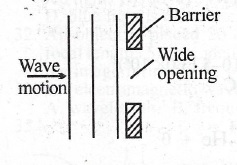
(i) Copy the diagram above in your answer booklet.
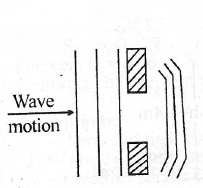
(iii) On the copied diagram, sketch the pattern of the waves immediately after passing through the opening.
(d) A diverging lens of focal length 18.0 in is used to view a shark that is 90.0 in away from the lens. If the image formed is 1.0 m long, calculate the:
(i) image distance;
(ii) length of the shark.
Explanation
(a)(i) Resonance is a phenomenon which occurs whenever a body is set in oscillation at its own natural frequency as a result of impulses received from another vibrating body, vibrating with the same frequency.
(ii) Examples of resonance are:
(1) Loud sound from vibrating prongs of a tuning fork.
(2) Bridge vibrating under uniform matching of soldiers.
(3) Repeated jumping of a diver at the free end of a diving board causes the board to resonate.
(4) Rattling of car engine at high speed causing vibrating of the body of the car. (5) X\(_{c}\) equals X\(_L\) in an L-C-R series circuit for tuning a radio set.
(iii)
|
Loudness |
Intensity |
|
- The magnitude of the sensation resulting from sound reaching the ear. -Sensation that depends on the individual hearing ability. |
- The time rate of flow of energy per unit area perpendicular to the direction of propagation of the sound. - Depends on physical quantities of energy, time and area |
(b) The following properties will change in speed and wavelength.
(c)
(d) \(\frac{1}{u} + \frac{1}{v} = \frac{1}{f}\)
\(\frac{1}{v} = \frac{1}{f} - \frac{1}{u} = \frac{1}{-18} - \frac{1}{90}\)
= \(\frac{-5 -1}{90}\)
v = -15m
M = \(\frac{u}{v} = \frac{h_i}{h_o}\)
\(h_o = \frac{hi \times u}{v} = \frac{1 \times 90}{1.5}\)
= 6.0 m