


You are provided with a variable d.c. power supply E, a 2\(\propto\) standard resistor, a key, an ammeter, a voltmeter and other necessary materials.
i. Set up a circuit as shown in the diagram above with E= 1.5V
ii. Close the key k.
iii. Take and record the voltmeter reading V.
iv. Take and record the corresponding ammeter reading l.
v. Evaluate V\(^{-1}\) and l\(^{-1}\)
vi. Repeat the procedure for four other values of E= 3.0V, 4.5V, 6.0V, and 7.4V.
vii. Tabulate your readings.
viii. Plot a graph with V\(^{-1}\) on the vertical axis and l\(^{-1}\) on the horizontal axis starting both axes from the origin (0, 0).
ix. Determine the slope, s, of the graph.
x. Also determine the intercept, e, on the vertical axis.
xi. State two precautions taken to obtain accurate results.
(b)i. State two methods by which an electric current can be produced.
ii

Calculate the value of R in the circuit diagram shown above, given that the effective resistance of the circuit is 4.0\(\Omega\) and the internal resistance of the cell is negligible.

You are provided with a beaker, a thermometer, a stirrer, a measuring cylinder, a bunsen burner, a wire gauze, a 50g mass, a pair of tongs, water, tripod stand, and other necessary materials.
i. Using the measuring cylinder, measure 150cm\(^{3}\) of water into the beaker.
ii. Record the volume v of the water in the beaker
iii. Calculate the mass m of the water, given that m = pv and; p = 1gcm\(_{-3}\).
iv. Measure and record the initial temperature \(\theta_{0}\) of the water in the beaker.
v. Hold the 50g mass with the pair of tongs in the flame of the bunsen burner for 2 minutes.
vi. Quickly transfer the 50g mass to water in the beaker.
vii. Stir gently and record the highest temperature \(\theta_{1}\), attained
viii. Evaluate \(\theta\) = (\(\theta_{1}\) – \(\theta_{0}\)).
ix. Empty the content of the beaker and repeat the procedures above for the values of v = 200cm\(^{3}\), 250cm\(^{3}\), 300cm\(^{3}\), and 350 cm\(^{3}\).
x. Tabulate your readings.
xi. Plot a graph with m on the vertical axis and \(\theta\) on the horizontal axis.
xii. Determine the slope, s, of the graph.
xiii. Evaluate k = \(\frac{50}{s}\).
xiv. State two precautions taken to obtain accurate results.
(b)i. Define heat capacity.
ii. An electric kettle rated 1.2kw is used to heat 800g of water initially at a temperature of 20 C. Neglecting heat losses, calculate the time taken for the kettle to heat the water to its boiling point. [Take the boiling point of water= 101 C specific heat capacity of water = 4200 Jkg’ K’1 (odv)

You are provided with a uniform metre rule, a knife-edge, some masses and other necessary materials.
i. Determine and record the centre of gravity of the metre rule.
ii. Fix the 100g mass marked N at a point Y, the 80cm mark of the rule using a sellotape.
iii. Suspend another 50g mass marked M at X, a distance A = 1Ocm from the 0cm mark of the rule.
iv. Balance the arrangement horizontally on the knife edge as illustrated in the diagram above.
v. Measure and record the distance B of a knife-edge from the 0cm mark of the rule.
vi. Repeat the procedure for four other values of A =15cm, 20cm, 25cm and 30cm.
vii. Tabulate your readings.
viii. Plot a graph with B on the vertical axis and A on the horizontal axis.
ix. Determine the slope, s, of the graph.
x. Also determine the intercept, c, on the vertical axis.
xi. Evaluate:
\(\propto\)) = k\(_{1}\) = (\(\frac{1 – 2s}{s}\))100
(\(\beta\)) = k\(_{2}\) = \(\frac{2c}{s}\) = 160
xii. State two precautions taken to obtain accurate results.
(b)i. Define the moment of a force about a point.
ii. State two conditions under which a rigid body at rest remains in equilibrium when acted upon by non-parallel coplanar forces.
(a) Explain the following terms:
(i) mass defect;
(ii) binding energy of a nucleus.
(b)(i) Assuming the wave nature of an electron, what is the effect of decreasing the speed of a photoelectron on its; (\(\alpha\)) wavelength? (\(\beta\)) energy?
(ii) A particle of friasS 4.4 x 10\(^{-23}\) kg moves with a velocity of 10\(^5\)ms\(^{-1}\). Calculate its wavelength. (h = 6.6 x 10\(^{-34}\) Js)
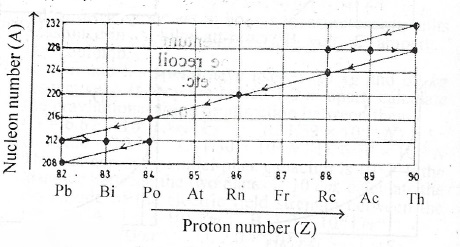
The diagram above shows part of a radioactive decay series. Use it to answer the following questions.
(i) Name a pair of isotopes.
(ii) Name the isotopes with which the series starts.
(iii) Write down a nuclear equation for two ekgmples of each of: (\(\alpha\)) alpha decay; (\(\beta\)) beta decay.
(a) Explain briefly dielectric strength.
(b) An electromagnetic wave has its wavelength shorter than those of radiowave and microwave but longer than that of visible light.
(i) Identify the wave.
(ii) Name one suitable detector for the wave.
(iii) Name one source of the wave.
(c) An oil drop carrying a charge of 1.0 x 10\(^{-19 }\)C is found to remain at rest in a uniform electric field of intensity 1200 NC\(^{-1}\). Calculate the weight of the oil drop.
(d) An RLC series circuit consists of a 100\(\Omega\) resistor, 0.05 H inductor and a 25 \(\mu\) capacitor. A 220 V, 50 Hz mains voltage is applied across the circuit. Calculate the:
(i) impedance;
(ii) current. (\(\pi\) = 3.14)
(a) Define critical angle.
(b) How are anti-nodes created in a stationary wave?
(c) The angle of minimum deviation of an equilateral triangular glass prism is 46.2°. Calculate the refractive index of the glass.
(d) An illuminated object is placed in front of a concave mirror and the position of a screen is adjusted in front of the mirror but no image is obtained on the screen. Give two possible reasons for this observation.
(e) An illuminated object is placed at a distance of 75 cm from a converging lens of focal length 30 cm.
(i) Determine the image distance.
(ii) If the lens is replaced by another converging lens, the object has to be moved 25 cm further away to have its sharp image on the screen. Determine the focal length of the second lens.
(a) Explain the terms:
(i) thermal equilibrium;
(ii) fundamental interval.
(b) List two uses of the hydraulic press.
(c) Name the material used to reset the steel index in the Six’s maximum and minimum thermometer.
(d)(i) A nursing mother prepared her baby’s milk mixture at 85°C, in a feeding bottle. In order to cool it to 40°C, she immersed the bottle in an aluminium bowl of heat capacity 90 JK\(^{-1}\) containing 500 g of water at 26°C. If the mass of the mixture is 300g, calculate the specific heat capacity of the mixture. [Neglect heat losses and heat capacity of the bottle; specific heat capacity of water = 4200 J kg\(^{-1}\) K\(^{-1}\)]
(ii) (\(\alpha\)) Name two ways through which the bottle losses heat.
(\(\beta\)) Name two industrial processes in which heat exchanger is used.
(a) Explain the term net force.
(b) Define the principle of conservation of linear momentum and state one example of it.
(c) A ball of mass 200 g released from a height of 2.0 m hits a horizontal floor and rebounds to a height of 1.8 in. Calculate the impulse received by the floor. (g = 10 ms\(^{-2}\)).
(d) A body of mass 20 g performs a simple harmonic motion at a frequency of 5 Hz. At a distance of 10 cm from the mean position, its velocity is 200 cms\(^{-1}\). Calculate its:
(i) maximum displacement from the mean position;
(ii) maximum velocity;
(iii) maximum potential energy. (g = 10 ms\(^{-2}\) \(\pi\) = 3.14)
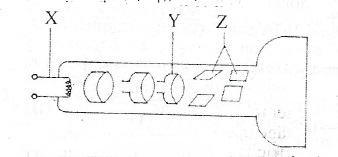
The diagram above illustrates a cathode ray tube. Identify the components X, Y, and Z.
(a) What is doping?
(b) Explain how doping improves the conductivity of a semiconductor
An electron enters perpendicularly into a uniform magnetic field which has a flux density of 0.12 T This results in a magnetic force of 9.6 x 10\(^{-2}\) N on the electron. Calculate the speed of the electron as it enters the magnetic field. (e =1.6 x \(10^{19}\) C)
State three different materials that can be used to demonstrate Brownian motion.
A projectile is fired with a velocity of 20 ms\(^{-1}\) at an angle of 40° to the horizontal. Determine the components of the velocity of the projectile at its maximum height.
Let \(\Delta\)x be the uncertainty in the measurements of position and \(\Delta\)p the uncertainty in measurement of momentum. The uncertainty principle relation is given as
- A. \(\Delta\)x . \(\Delta\)p = h
- B. \(\Delta\)x . \(\Delta\)p \(\leq\) = h
- C. \(\Delta\)x . \(\Delta\)p \(\geq\) = h
- D. \(\Delta\)x . \(\Delta\)p > h

In a p-type semiconductor, the?
- A. number of holes are equal to the number of electrons
- B. electrical resistivity increases
- C. electrons are the majority charge carriers
- D. holes are the majority charge carriers
The phenomenon by which two light atomic nuclear combine to form a heavy nuclide with the release of energy is known as
- A. radioactivity
- B. nuclear fusion
- C. nuclear fission
- D. chain reaction
How many beta particle(s) are emitted in the radioactive decay of \(^{198}_{79}Au \leftarrow ^{198}_{80}Hg\)?
- A. 1
- B. 2
- C. 3
- D. 5
What determines the polarity at the ends of an electromagnet? The
- A. magnitude of the current passing through the wire
- B. material of the core of the magnet
- C. material of the coil
- D. direction of current in the wire
Which of the following statements is not correct about steel and soft iron?
- A. steel is more magnetized than soft iron
- B. permanent magnets are usually made of steel
- C. soft iron is more readily magnetized than steel
- D. soft iron more readily loses its magnetism than steel