


You are provided with cells, a potentiometer, an ammeter, a voltmeter, a bulb, a key, a jockey, and other necessary materials.
i. Measure and record the e.m.f E of the battery.
ii. Set up a circuit as shown in the diagram above.
iii. Close the key K and use the jockey to make a firm.
iii. Contact at J on the potentiometer wire such that PJ = x= 10cm.
iv. Take and record the voltmeter reading V and the () Corresponding ammeter reading.
v. Evalute log V and log I.
vi. Repeat the procedure for five other values of x = 20 cm, 30 cm, 40 cm, 50 cm, and 60 cm.
vii. Tabulate your readings.
viii. Plot a graph with log I on the vertical axis and log V on the horizontal axis.
ix. Determine the slope s, of the graph.
x. Determine the intercept, c, on the vertical axis.
xi. State two precautions taken to ensure accurate results.
(b)i. How is the brightness of the bulb affected as x increases?
ii. List two electrical devices whose actions do not obey Ohm’s law.

You are provided with a beaker, a thermometer, a stirrer Stopwatch/clock, measuring cylinder, table salt, water, and other necessary materials.
i. You Measure 200cm\(^{3}\) of water into the beaker.
ii. Heat the water until it boils steadily for about 2 minutes.
iii. Read and record the boiling point b\(_{0}\).
iv. Add table salt of mass M = 10.0 g to the boiling water and stir continuously until another boiling point b\(_{1}\) is attained.
v. Read and record b\(_{i}\).
vi. Evaluate \(\theta_{i}\) = (b\(_{i}\) – b\(_{0}\))
vii. Using the same mixture, repeat the procedure four more times by adding 10.0 g of salt each time to give the cumulative mass M\(_{i}\) of salt as 20 g, 30g, 40g, and 50g.
viii. In each case allow the mixture to boil steadily for at least 2 minutes then read and record the boiling point b.
ix. Tabulate your readings.
x. Plot a graph with M\(_{i}\) on the vertical axis and \(\theta_{1}\) on the horizontal axis.
xi. Determine the slope, s, of the graph.
xii. State two precautions taken to ensure accurate results.
(b) i. Define the boiling point of a liquid.
ii. What effects do impurities have on the boiling point of a liquid?

You are provided with two retort stands, two-metre rules, pieces of thread, and other necessary apparatus. ( see illustration above)
i. Set up the apparatus as illustrated above ensuring the strings are permanently 10cm from either end of the rule.
ii. Measure and record the length L = 80 cm of the two strings.
iii. Hold both ends of the rule and displace the rule slightly, then release so that it oscillates about a vertical axis through its centre.
iv. Determine and record the time t for 10 complete oscillations.
v. Determine the period T of oscillations.
vi. Evaluate log T and L.
vii. Repeat the procedure for four other values of L= 70 cm, 60 cm, 50 cm, and 40 cm
viii. Tabulate your readings.
ix. Plot a graph with log T on the vertical axis and log L on the horizontal axis.
x. Determine the slope, s, and the intercept, c on the vertical axis.
xi. State two precautions taken to ensure accurate results.
(b)i. Define simple harmonic motion.
ii. Determine the value of L corresponding to t= 12 s from the graph in 1.
(a) (i) What is nuclear fission?
(ii) State the function of each of the following ma-terials in a nuclear fision reactor:
(\(\alpha\)) graphite, (\(\beta\)) boron rods; (\(\gamma\)) liquid sodium
(b) The table below gives some of the energy levels of a hydrogen atom.
| n | 1 | 2 | 3 | 4 | 5 | \(\infty\) |
| E\(_n\)/\_eV\) | -13.60 | -3.39 | -1.51 | -0.85 | -0.54 | 0.00 |
(i) Draw the energy level diagram for the atom.
(ii) Determine the wavelength of the photon emitted when the atom goes from the energy state n = 3 to the ground state. [h = 6.6 x 10\(^{-34}\) Js, c = 3 x 10\(^{8}\)ms\(^{-1}\), e = 1.6 x 10\(^{-19}\)]
(c) A piece of ancient bone from an excavation site showed \(^{14}_{6}\)C activity of 9.5 disintegrations per minute per 1.0×10\(^{-3}\)kg. If a bone specimen from a living creature shows \(^{14}_{6}\)C activity of 12.0 disintegrations per minute per 1.0 x 1 0\(^{-3}\), determine the age of the ancient bone. [Half – life of \(^{14}_{6}\)C = 5572 years].
(i) What is dielectric?
(ii) A parallel plate capacitor consists of two plates each of area 9.6 x 10\(^{-2}\)m\(^2\), separated by a dielectric of thickness 2.25 x 10\(^{-3}\) and dielectric constant 900. Calculate the capacitance of the capacitor. [ \(\varepsilon_o\) = permittivity of free space = 8.85 x 10\(^{-12}\)Fm\(^{-1}\)]
(b) (i) Which of the following devices has a higher resistance; an ammeter or a voltmeter? Give a reason for your answer.
(ii)
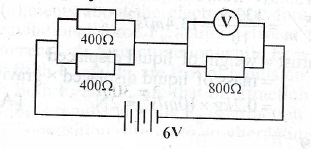
The resistance of the voltmeter in the circuit diagram illustrated above is 800\(\Omega\), Calculate the voltmeter reading.
(c)
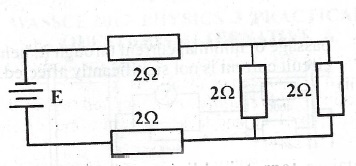
A battery of negligible internal resistance is connected to a set of resistors as illustrated in the circuit diagram above. Determine the equivalent resistance of the circuit.
(a) What is a wavefront?
(b) (i) State two practical uses of glass prisms.
(ii) List two factors that determine the deviation of a ray of light travelling from air into a triangular glass prism.
(iii) Sketch a graph to illustrate the variation of the angle of deviation d, with that of incidence, i, for a ray of light travelling from air into a triangular glass prism. Indicate on the graph the point at which the angle of incidence equal to the angle of emergence e.
(c) (i) Draw and label a diagram of an astronomical telescope in normal adjustment.
(ii) The angular magnification of an astronomical telescope in normal adjustment is 5. If the focal length of the objective is 100cm, calculate the:
(\(\alpha\)) focal length of the eyepiece;
(\(\beta\)) length of the telescope.
(a) Define stable equilibrium as applied to a rigid body.
(b) Sketch a block and tackle system of pulleys with a velocity ratio of 3.
(c) At the beginning of a race, a tyre of volume 8.0 x 10\(^{-4}\) at 20°C-has a gas pressure of 4.5 x 10\(^5\) Pa. Calculate the temperature of the gas in the tyre at the end of the race if the pressure has risen to 4.6 x 1 0\(^5\) Pa.
(d)(i)
|
Ice point 273k |
373k Steam point |
|
|
Resistance/\(\Omega\) |
5.67 | 7.75 |
|
Pressure/Pa |
7.13 x 10\(^4\) | 9.74 x 10\(^4\) |
The table above shows readings of the resistance and pressure of a platinum resistance thermometer and a constant-volume gas thermometer respectively, when immersed in the same liquid bath. Use this data to determine the temperature of the bath on the: (\(\alpha\)) resistance thermometer; (\(\beta\)) gas thermometer
(ii) By what percentage is the temperature measured on the platinum resistance thermometer in error?
(a) State two deductions that can be made from a displacement-time graph.
(b) If the distance beween two equal masses is doubled and their individual masses are also doubled, what would happen to the force between them? Support your answer quantitatively.
(c) State two factors that affect the maximum height attained by a bullet fired from a gun.
(d) State two practical examples of mechanical resonance. A body is released from rest at the top of a plane inclined at 30° to the horizontal and 4.0 m high. If the coefficient of friction between the body and the plane is 0.3, calculate the time the body takes to reach the bottom of the plane.
(a) State two factors on which surface tension depends.
(b) How can mosquito larvae be made to sink in stagnant water?
A spiral spring has a length of 14cm when a force of 4N is hung on it. A force of 6N extends the spring by 4cm. Calculate the unstretched length of the spring
List three phenomena which can be explained by the molecular theory of matter.
A particle is projected horizontally at 15ms\(^{-1}\) from a height of 20m. Calculate the horizontal distance covered by the particle just before hitting the ground. [g= 10ms\(^{-2}\)]
A particle is dropped from a vertical height h and falls freely for a time t. With the aid of a sketch, explain how h varies with \(t^2\)
| Radio wave | Micro wave | Infrared wave | P | Q | R | Gamma Ray |
The table above shows the components of electromagnetic spectrum in order of increaasing frequency.Which of the following sets correctly identifies P, Q, R respectively?
- A. Visible, ultraviolet, X-ray
- B. X-ray, visible, ultraviolet
- C. Ultraviolet, visible, X-ray
- D. X-ray, ultraviolet, visible

Which of the following statements about Gamma radiation is correct? Gamma radiation can
- A. be seen by the naked eye
- B. not pass through an aluminium foil
- C. be present naturally in our surroundings
- D. be used as a tracer
| n = \(\alpha\) | 0.06eV |
| E=3 | -1.6eV |
| E=2 | -3.7eV |
| E=1 | -5.5eV |
| E=0 | -10.4eV |
The energy levels in the mercury atom is illustrated in the table above. Calculate the ionisation energy of the atom.
- A. +21.2eV
- B. +10.4eV
- C. -10.4eV
- D. -21.2eV
The nucleon number of an atom is the total number of
- A. electrons and protons
- B. electrons and neutrons
- C. neutrons minus electrons
- D. protons and neutrons
Which of the following pairs of concepts constitutes complementary variables as expressess by the Heinsberg uncertainty principle?
- A. Momentum and time
- B. Energy and acceleration
- C. Position and momentum
- D. Velocity and Momentum
The opposition offered to an alternating current in a C-R series circuit is known as
- A. impedance
- B. resistance
- C. reactance
- D. friction