

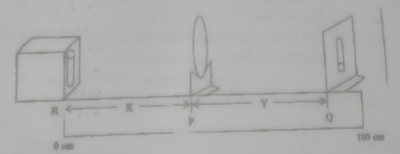
You are provided with a converging lens and holder, a screen, a ray box containing an illuminated object pin, and a meter rule.(See illustration above)
i. Place the lens in its holder such that it is facing a distant object seen through a well-lit laboratory window. Move the screen to and fro until a sharp image of the distant object is formed on it. Measure the distance, f\(_{0}\), between the screen and the lens.
ii. Clamp the meter rule securely to the table. Place the illuminated object pin at the end R of the meter rule.
iii. Place the lens at a position P such that X = RP = 20cm.
iv. Move the screen to a position Q to receive a sharp image of the object. Measure the distance Y = PQ.
v. Evaluate Z = (X+Y)
vi. Repeat the procedure for five other values of x = 25cm. 3Ocm, 35cm, 40cm and 45cm. In each case, record X,Y and evaluate Z.
vii. Tabulate the results.
viii. Plot a graph with Z on the vertical axis and X on the horizontal axis. Draw a smooth curve through the points.
ix. Determine from your graph the minimum value of Z=Z\(_{0}\) and its corresponding distance
x. Evaluate W = ½ (\(\frac{Z_0}{4} + \frac{X_0}{2}\))
xi. State two precautions taken to ensure accurate results.
(b) i. Draw a ray diagram to show how a Convex lens forms an image of magnification less than one.
ii. Name two pairs of features in the human eye and a lens camera that performs similar functions.
Explanation

F = 13.0cm
Table of value
| S/N | Xcm | Ycm | Z(x+y)cm |
| 1 2 3 4 5 6 |
20 25 30 35 40 45 |
60 38 30 26 24 21 |
80 63 60 61 64 61 |
See graph above
Let 1cm represent5 units on the vertical axis and 1cm represent 5 units on the horizontal axis.
Minimum value of Z=Z\(_{0}\) from the graph = 60cm
Corresponding distance of X\(_{0}\) = 30cm
Evaluate W = ½ (\(\frac{Z_0}{4} + \frac{X_0}{2}\))
= ½(\(\frac{60}{40} + \frac{30}{2}\)
= ½(\(\frac{60 + 60}{4}\) = ½\(\frac{120}{4}\)
= ½(30) = 15
Precautions
- Coaxial arrangement of optional instruments/ray box, len and screen on a straight line.
- Avoided parallax error in reading metre rule.
- Lens kept uptight
- Repeated reading shown on table
- Surface of lens cleaned
- Noted/corrected/avoided zero error on metre rule.
(b)i.
See the diagram above(bi)
ii. Features performing the same function
| Human eye | Lens camera |
| Retina | Film/screen |
| Eye lens | Camera lens |
| Iris | Diaphragm |
| Pupil | Aperture |