

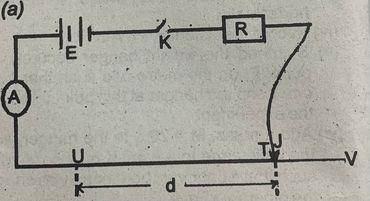
You are provided with a battery of e.m.f, E, a standard resistor, R, of resistance 2 \(\Omega\), a key, K, an ammeter, A, a jockey, J, a potentiometer, UV, and some connecting wires.
(i) Measure and record the emf, E, of the battery.
(ii) Set up the circuit as shown in the diagram above with the key open.
(iii) Place the jockey at the point, U, of the potentiometer wire. Close the key and record the reading, i, of the ammeter.
(iv) Place the jockey at a point T on the potentiometer wire UV such that d = UT = 30.0 cm.
(v) Close the circuit, read and record the current, I, on the ammeter,
(vi) Evaluate I\(^{1}\).
(vi) Repeat the experiment for four other values of d = 40.0 cm, 50.0 cm, 60.0 cm and 70.0 cm. In each case, record I and evaluate I\(^{1}\).
(vii) Tabulate the results
(ix) Plot a graph with d on the vertical axis and I on the horizontal axis stalling both axes from the origin (0,0).
(x) Determine the slope, s, of the graph.
(xi) From the graph determine the value I\(_{1}\), of I when d = 0. (ci) Given that=s, calculate 8.
(xii) State two precautions taken to ensure accurate results.
(xii) Given that \(\frac{E}{\delta}\) = s, calculate \(\delta\).
(b)(i) Write down the equation that connects the resistance, R, of a wire and the factors on which it depends. State the meaning of each of the symbols.
(ii) An electric fan draws a current of0.75 A in a 240 V circuit. Calculate the cost of using, the fan for 10 hours if the utility rate is $ 0.50 per kWh.
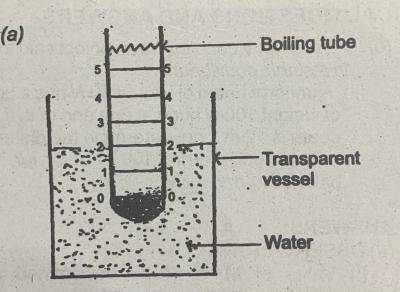
You are provided with a loaded boiling tube with a centimeter scale fixed inside it, a transparent vessel filled with water, standard masses 2 g, 5g and 10 g, and a slide vernier caliper. Use the diagram above as a guide to perform the experiment.
(i) Use the slide vernier caliper to measure and record the external diameter, D, of the boiling tube.
(ii) Evaluated A = 0.25\(\pi\)D\(^{2}\), where \(\pi\) = 3.14.
(iii) Place the loaded boiling tube gently in the water in the transparent vessel such that it floats vertically.
(iv) Read and record the depth of immersion, y, from the zero mark of the scale fixed inside, the boiling tube.
(v) Add a mass, m = 2g, to the boiling tube. Read and record the new depth of immersion, y, from the zero mark of the scale.
(vi) Evaluate h = (y – y\(_{0}\)), log h and log m.
(vii) Repeat the experiment for four other values of m = 5g, 7g, 10 g, and 12g. In each case, record y and evaluate h, log h, and log m.
(viii) Tabulate the results.
(ix) Plot a graph with log m on the vertical axis and log h on the horizontal axis starting both axes from the origin (0,0).
(b)(i) State in full the law on which the experiment in (a) is based.
(ii) A uniform cylindrical rod is 0.63 m long and it has a cross-sectional area of 0.1 m\(^{2}\). Calculate the depth of immersion of the rod if it floats vertically in a liquid of relative density 1.26. [density of rod =720 kg m\(^{-3}\), g = 10 m s\(^{-2}\)].
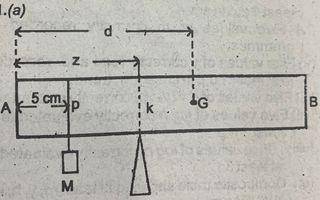
You are provided with a metre rule, a weight hanger, slotted masses, M, a piece (if string, a weighing balance and a knife edge. Use the diagram above as a guide to perform the experiment.
(i) Using the weighing balance, determine and record the mass, M\(_{o}\), of the unloaded metre rule.
(ii) Determine and record the mass, m, of the weight hanger.
(ii) Suspend the metre rule horizontally on the knife edge. Adjust the knife edge to a point G on the metre rule where it balances horizontally.
(iv) Record the distance, d = AG.
(v) Suspend the weight hanger securely at a point, P, on the metre rule such that AP= 5 cm. Keep the hanger at this point throughout the experiment
(vi) Add a mass, M = 20 g to the hanger, adjust the knife edge to a point K on the metre rule such that it balances horizontally as shown in the diagram above.
(vii) Determine and record the distance z = AK.
(vii) Record M and evaluate y – (z – 5), x – (d – z] and v = \(\frac{x}{y}\)
(ix) Repeat the experiment for M = 40 g, 60 g, 80 g and 100 g. In each case, evaluate y, x and v.
(x) Tabulate the results.
(xi) Plot a graph with M on the vertical axis and v on the horizontal axis, sinning both axes from the origin (0,0).
(xii) Determine the slope, s, of the graph.
(xii) Determine the intercept, c, on the vertical axis.
(xiv) State two precautions taken to ensure accurate results.
(b) (i) Under what condition is an object said to be in a stable equilibrium
(ii) Auniform beam of weight 50 N has a body of weight 100 N hung at one end of it. If the beam is 12 m long, determine the distance of a support from a 100 N body for it to balance horizontally.
(a)(i) What is meant by the term artificial radioactivity?
(ii) Complete the table below
| Emission | Nature | Charge | Ionizing |
| High speed electron | Moderately ionizing | ||
| Neutral | Negligible ionizing ability | ||
| Alpha particles | Positive |
(b) In an x-ray tube, an electron is accelerated from rest towards a metal target by a 30 kV source. Calculate the kinetic energy of the electron. [e=1.6 x 10\(^{-19}\)C]
(c) The table below shows the frequencies of radiations incident on a certain metal and the corresponding kinetic energies of the photoelectrons.
| Frequency x 10\(^{14}\)(Hz) | 6.8 | 8.0 | 9.2 | 10.0 | 11.0 |
| Kinetic energy x 10\(^{-19}\)(j) | 0.8 | 1.6 | 2.4 | 2.9 | 3.8 |
(i) Plot a graph of kinetic energy, K.E, on the vertical axis and frequency, f, on the horizontal axis starting both axes from the origin (0,0).
(ii) From the graph, determine the:
i. Planck’s constant;
ii. Threshold frequency of radiations;
iii. Work function of the metal.
(a) State two factors that affect the rate of evaporation of a liquid.
(b) Explain the term latent heal.
(c) Explain each of the following phenomena:
(i) On a dry day, water in a clay pot is cooler than water in a rubber container:
(ii) Cooking of food is faster in a pressure cooker than in an ordinary pot.
(d) A 40 V electric heater is used to supply a current of 12 A for 1400 seconds to a body mass of 1.5 kg at its melting point. The body melts and its temperature rises by 60°C in an extra 1.2 minutes, Calculate the:
(i) Latent heat of fusion of the body
(ii) Specific heat capacity of the body.
(e) State two differences between evaporation and boiling.
(a) State one condition each necessary for the characteristics each of the following occurrences:
(i) Constructive interference of waves.
(ii) Total internal reflection.
(iii) Production of beats.
(b) In a resonance tube experiment using a tuning fork of frequency 256 Hz, the first position of resonance was 35 cm, the next position was 100 cm. Calculate the velocity of sound in air from the experiment.
(c)(i) State the three classifications of musical instalments
(ii) Give one example each of the classifications stated in (c)(i).
(d) Calculate the critical angle for light traveling from glass to air. [refractive index of glass = 1.5].
(e) The speed of sound in a medium at a temperature of 102 °C is 240 m s\(^{-1}\). If the speed of sound in the medium is 3 10 m s\(^{-1}\). Calculate its temperature

(a)(i) State Coulomb’s law of electrostatics.
(ii) The electron and proton of a hydrogen atom are separated by a mean distance of 5.2 x 10\(^{-11}\)m.
Calculate the magnitude of the electrostatic force between the particles.
[e = 1.6 x 10\(^{-19}\) C, (4\(\pi\) \(\mathcal{E}_{0}\))\(^{-1}\) = 9.0 x 10\(^{9}\) mF\(^{1}\)]
(b) The diagram above shows a potential divider circuit. (see diagram above)
i. Show that V\(_{out}\) = V\(_{in}\) (\(\frac{R_{1}}{R_{1} + R_{2}})\)
ii. If \(\frac{V_{in}}{V_{out}}\) = 2.5 and R\(_{2}\) = 30\(\Omega\), calculate R\(_{1}\)
iii. Define the volt.
(c) Explain why wood is not suitable for use as the core of transformers.
(d) State one application for the cathode ray tube.
(a)(i) State the law of inertia.
(ii) Use the law stated in (a)(I) to explain how wearing a safety belt in a moving vehicle could reduce the possibilities of severe injuries when the vehicle is involved in a collision.
(b)(I) Define the term moment of a force.
(ii) A uniform plank measures 2 m long from its ends point A to point B. If the weight of the plank is 54 N and it rests on a knife edge 0.50 m from end B and point A is supported by a vertical string so that AB balances horizontally:
i. Draw a force diagram for the arrangement;
ii. Determine the tension, T, in the string.
iii. Determine the force, F, acting on the knife edge
(c) State three differences between solid friction and viscosity
(d) State one method of increasing the velocity ration of a pulley system.
State three differences between magnetic and non-magnetic materials.
State:
(a) The S.I. unit of the intensity of a blackbody radiation.
(b) Two features of the intensity-wavelength graph of a perfect blackbody at different temperatures.
(a) What is a geostationary satellite?
(b) Name two types of Lasers.
A 50 N force is applied to the free end of a spiral spring of force constant, 100 N m\(^{-1}\). Calculate the work done by the force to stretch the spring.
The effective potential energy, E, of a lunar satellite of mass, m, moving in an. elliptical orbit around the moon of mass, m, is given by
E = \(\frac{K^{2}}{2m_{1}r^{2}} – \frac{Gm_{1}m_{2}}{r}\) where r is the distance of the satellite from the mooń and G is the universal gravitational constant of dimensions, M\(^{-1}\)L\(^{3}\)T\(^{2}\).
Ďetermine the dimensions of the angular momentum, K, of the satellite using dimensional analysis.

The diagram above illustrates the trajectory of a fired missile from point P at 250 ms-1
If the missile point Q after 40 s, calculate the distance |PQ|
In which of the following situations is friction not useful?
- A. Operation of a grinding machine
- B. Walking
- C. Application of brakes
- D. Moving piston in a sleeve

The basic principle of operation of a beam balance is——————
- A. Hooke's law
- B. Archimedes principle
- C. law of flotation
- D. principle of moments
Using venier calipers, which of the following readings gives the correct measurement for the length of a rod?
- A. 4.1 cm
- B. 4.13cm
- C. 125 cm
- D. 1254 cm
The viscosity of a fluid depends on the following factors except the?
- A. relative motion between the layers of the fluid
- B. nature of the material of the fluid
- C. surface area of the fluid in contact
- D. normal reaction in the fluid
Molecules move in random motion within a liquid. The total internal energy of the liquid depends on all of the following except its?
- A. temperature
- B. mass
- C. specific heat capacity
- D. melting point
A small object of mass 50 g is released from a point A. Determine the velocity of the object when it reaches a point B, a vertical distance of 30m below A. [g = 10 ms\(^{-2}\)
- A. 1.5 ms\(^{-1}\)
- B. 6.0 m s\(^{-1}\)
- C. 17.3 m s\(^{-1}\)
- D. 24.5 m s\(^{-1}\)