



ANWSER
Question 1:
(a)
i. Network Diagram:
– Start with activities A, B, and C (no predecessors).
– D depends on B.
– E depends on A and D.
– F depends on C.
– G depends on E and F.
“`
A(2) → E(3) → G(8)
B(5) → D(10) → E(3) → G(8)
C(1) → F(6) → G(8)
“`
ii. Critical Path:
– Calculate paths:
– A → E → G: 2 + 3 + 8 = 13 days
– B → D → E → G: 5 + 10 + 3 + 8 = 26 days
– C → F → G: 1 + 6 + 8 = 15 days
– Critical Path: B → D → E → G (longest duration).
iii. Total Project Completion Date: 26 days.
iv. Slack Time:
– A: 26 – (2 + 3 + 8) = 13 days
– B: 0 (on critical path)
– C: 26 – (1 + 6 + 8) = 11 days
– D: 0 (on critical path)
– E: 0 (on critical path)
– F: 26 – (1 + 6 + 8) = 11 days
– G: 0 (on critical path)
—
Question 2:
a. Performance vs. Organizational Citizenship Behaviors (OCB):
– Performance: Task-focused, measurable outcomes tied to job description.
– OCB: Voluntary actions (e.g., helping colleagues) not formally rewarded.
b. Improving Performance:
– Set clear goals, provide feedback, offer training, and align rewards with performance.
c. Negative OCB Example:
– Overworking to “help” may lead to burnout, lowering team productivity.
d. Turnover Bonus Effectiveness:
– Pros: Reduces recruitment costs.
– Cons: May retain underperformers; focus should be on job satisfaction and growth.
—
Question 3:
a. Committee Definition:
– A group formed to address specific tasks or decisions collaboratively.
b. Formal Procedure:
1. Define purpose and scope.
2. Select members with relevant expertise.
3. Appoint a chairperson.
4. Set meeting schedules and reporting lines.
c. Reasons for Committees:
– Diverse input, specialized focus, shared responsibility.
d. Advantages:
– Enhanced decision-making through collective expertise.
– Distributed workload among members.
—
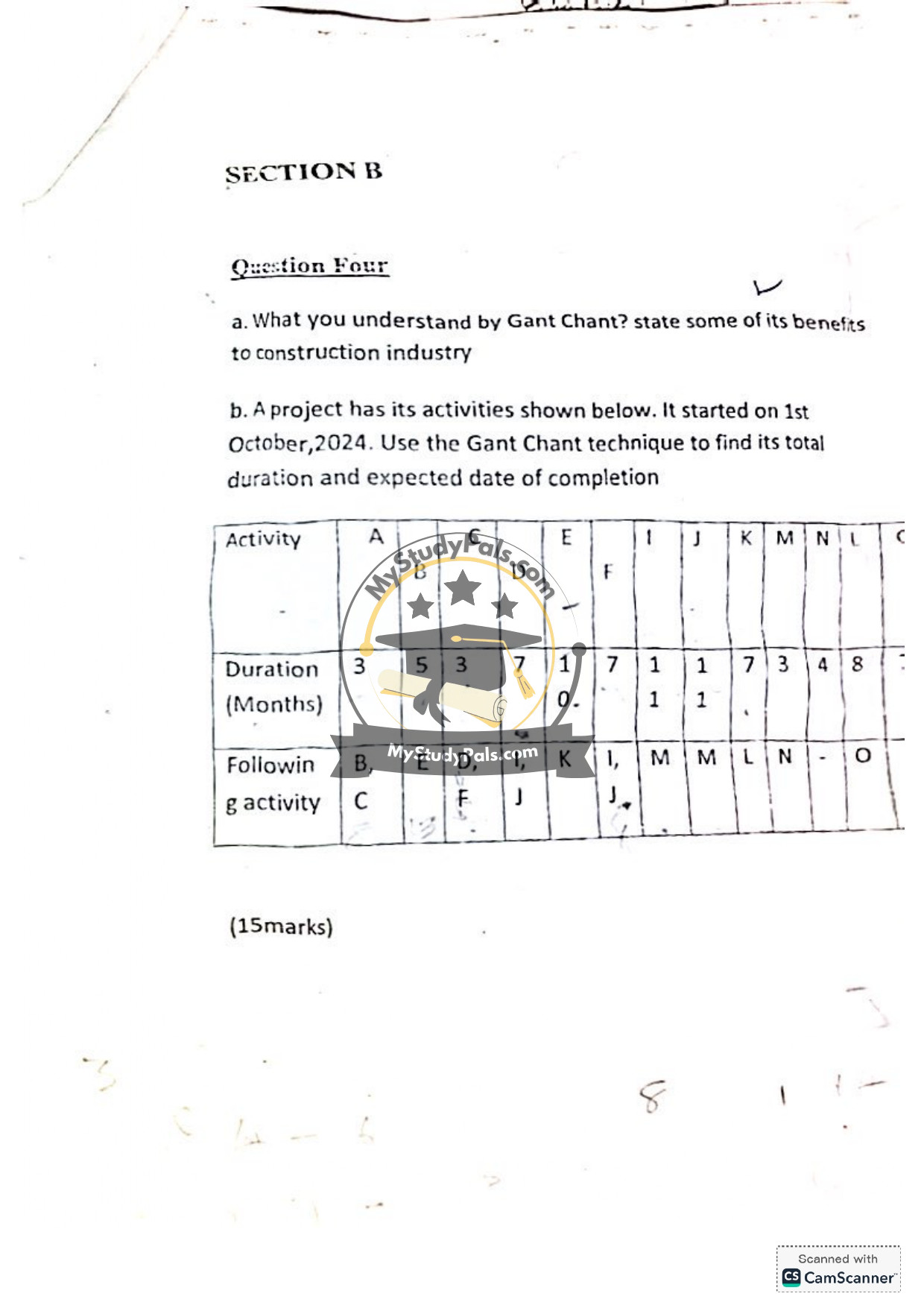
Question 4:
a. Gantt Chart:
– Visual timeline showing tasks, durations, and overlaps.
Benefits:
– Tracks progress, clarifies dependencies, aids resource allocation.
b. Project Duration Calculation:
– Critical Path: Longest path (e.g., A → B → E → I → K → M → N → O).
– Total Duration: Sum of critical path activities (e.g., 3 + 5 + 3 + 7 + 7 + 1 + 1 + 8 = 35 months).
– Completion Date: 1st October 2024 + 35 months = 1st September 2027.
—
Question 5:
a. Selection Methods for High Performers:
– Structured interviews, work samples, cognitive ability tests.
b. Absenteeism Causes & Solutions:
– Causes: Poor morale, health issues.
– Solutions: Flexible schedules, wellness programs, engagement initiatives.
c. Behavior & Job Performance:
– Predictors: Conscientiousness, emotional stability, job knowledge.
—
Question 6:
a. Network Analysis:
– Planning method to map project tasks and dependencies.
b. Network Techniques:
– CPM, PERT, GERT, PDM, LOB, WBS.
c. Definitions:
– Optimistic Time: Shortest estimated duration.
– Expected Time: Most likely duration.
– Slack/Float: Delay allowance without affecting timeline.
d. Diagram Terms (Not drawn here):
– Node: Circle representing start/end.
– Activity: Arrow-labeled task.
– Dummy Activity: Dashed arrow (no work, shows dependency).
e. Programming vs. Scheduling:
– Programming: High-level phase sequencing.
– Scheduling: Detailed timeline with dates/resources.
—