

Which of the following statements is true of the properties of a moving coil galvanometer?
- A. THe coil has a small area
- B. There are strong hair springs to gives a large control panlel
- C. There is a strong permanent magnet to give high magnetic flux
- D. it has a small number of turns of coil

A current of 0.5 A flowing 3h Deposits 2g of metal during electrolysis. The quantity of the same metal that would be deposited by the currents of 1.5A flowing in 1h is
- A. 2g
- B. 6g
- C. 10g
- D. 18g
At what frequency would a capacitor of 2.5μF
used in radio circuit have a resistance of 250Ω
- A. π/800 Hz
- B. 800/π Hz
- C. 200π Hz
- D. 2000π Hz
The carbon-granules microphone works on the principle of change in
- A. inductance
- B. resistance
- C. capacitance
- D. voltage
A transistor is used in the amplification of signals because it
- A. controls the flow of current
- B. consumes a lot of power
- C. allows doping
- D. contains electron and hole carriers
The particle that is responsible for the nuclear fission in a nuclear reactor is
- A. neutron
- B. prton
- C. electron
- D. photon
From the generating station to each substation power is transmitted at a very high voltage so as to reduce
- A. hysteresis loss
- B. eddy current loss
- C. magnetic flux leakage
- D. heating in the coils
The percentage of the original nuclei of the sample of a radioactive substance left after 5 half – lives is
- A. 8%
- B. 5%
- C. 3%
- D. 1%
The energy associated with the photon of a radio transmission at 3 x 10⁵ Hz is
[h = 6.63 x 10⁻³⁴Js]
- A. 2.00 x 10⁻²⁸J
- B. 1.30 x 10⁻²⁸J
- C. 2.00 x 10- 29J
- D. 1.30 x 10⁻²⁹J
Pure silicon can be converted to a p-type by adding a controlled amount of
- A. trivalent atoms
- B. tetravalent atoms
- C. pentavalent atoms
- D. hexavalent atoms
| 23 | Na + X → | 20 | F + | 4 | He | |
| 11 | 9 | 2 |
What particle is X in the reaction above?
- A. Alpha
- B. Beta
- C. Neurons
- D. Gamma
an electric cell with nominal voltage E has a resistance of 3Ω connected across it. If the voltage falls to 0.6E, the internal resistance of the cell is
- A. 1Ω
- B. 2Ω
- C. 3Ω
- D. 4Ω
The electromagnetic wave that can produce a heating effect on the environment is
- A. x -rays
- B. ultraviolet rays
- C. infrared rays
- D. gamma rays

The electric field between two – point charges is shown in the diagram above. What types of charges are at X and Y?
- A. Both X and Y are negative
- B. Both X and Y are positive
- C. X is positive and Y is negative
- D. X is negative and Y is positive
An electric iron is rated 1000W, 230V. What is the resistance of its elements?
- A. 51.9Ω
- B. 52.9Ω
- C. 55.9Ω
- D. 57.6Ω
The eye controls the amount of light reaching the retina by adjusting the
- A. cornea
- B. iris
- C. retina
- D. optic nerve
When connected to a mains of 250V, the fuse rating in the plug of an electric device of 1 KW is
- A. 2 A
- B. 3 A
- C. 4 A
- D. 5 A
The energy stored in a capacitor of capacitance 10μF carrying a charge of 100μC
- A. 5 x 10⁴ J
- B. 4 x 10² J
- C. 4 x 10⁻³ J
- D. 5 x 10⁻⁴ J
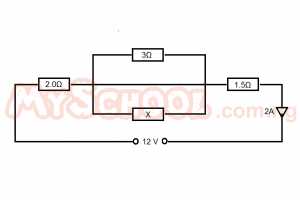
From the diagram above, determine the value of the resistance X
- A. 6Ω
- B. 9Ω
- C. 12Ω
- D. 15Ω
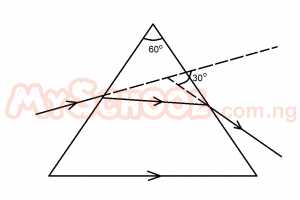
Calculate the refractive index of the material for the glass prism in the diagram above
- A. √2/2
- B. 4/3
- C. √2
- D. 3/2
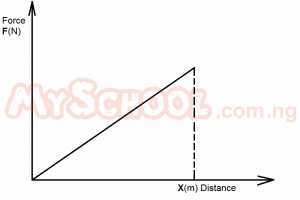
The diagram above shows the force (F) acting on an object through a distance (x). The work done on this object is expressed as
- A. Fx J
- B. Fx/2 J
- C. Fx2 J
- D. F/x J